
The Growing Threat of AI-Powered Voice Impersonation
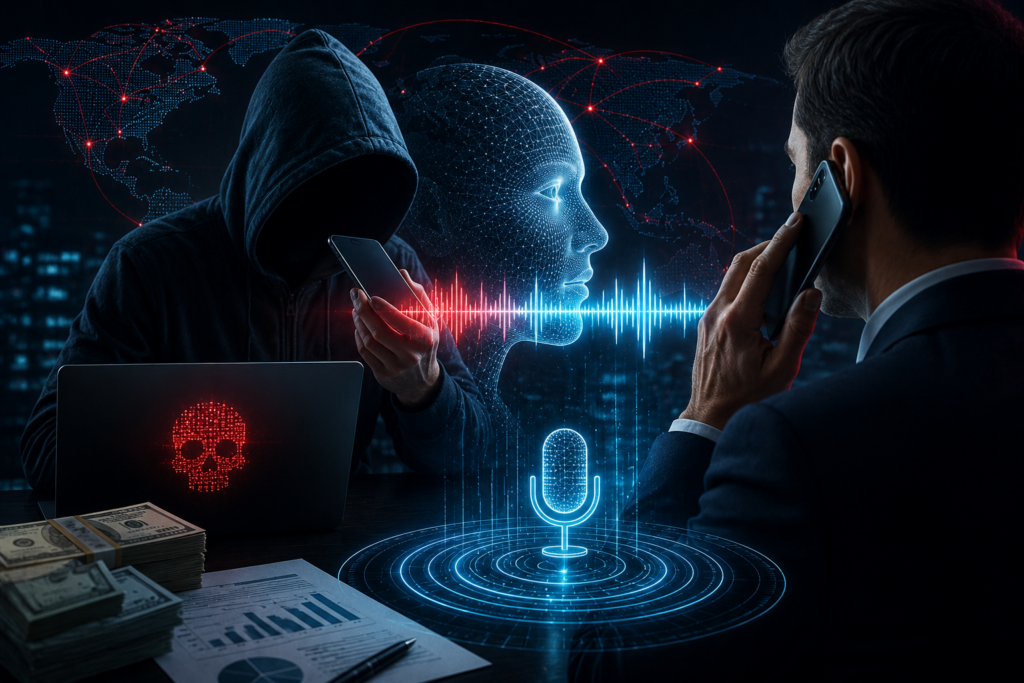
Cybercrime is entering a new phase where artificial intelligence is no longer just a defensive tool; it is also a powerful offensive weapon. Among the most concerning developments is the rise of voice cloning scams, where attackers use AI to replicate human voices with alarming accuracy. These attacks are redefining social engineering by making fraud more personal, convincing, and difficult to detect.
According to Deloitte, generative AI-driven fraud attempts increased by more than 60% between 2022 and 2024 (Deloitte, 2024). This surge reflects how rapidly cybercriminals are adopting AI technologies to enhance traditional scams.
From a cybersecurity consultant’s perspective, voice cloning scams represent a major shift in identity-based threats, where trust itself becomes the primary attack surface.
What Are Voice Cloning Scams?
Voice cloning scams are a form of AI-powered cyber fraud where attackers use machine learning models to replicate a person’s voice. These synthetic voices are then used to impersonate executives, employees, or trusted individuals in order to manipulate victims into taking harmful actions.
Unlike traditional vishing (voice phishing), which relies on human impersonation over the phone, voice cloning scams use AI-generated audio that closely mimics tone, emotion, and speech patterns.
A data security consultant views this as an evolution of identity fraud where biometric traits such as voice become exploitable digital assets.
Related: Medusa Ransomware: How This Threat Is Targeting Modern Enterprises
How Voice Cloning Scams Work
Voice cloning scams follow a structured attack lifecycle designed to maximize trust and deception.
Voice Data Collection
Attackers begin by collecting voice samples from publicly available sources such as social media videos, webinars, customer service calls, or leaked recordings. Even a few seconds of audio can be enough to train modern AI models.
AI Model Training
Using generative AI systems, attackers train deep learning models to replicate voice characteristics. Text-to-speech and neural voice synthesis technologies enable highly realistic voice generation.
Real-Time Impersonation
Once trained, the cloned voice is used in real-time or pre-recorded messages. Attackers often impersonate executives or family members to create urgency and emotional pressure.
Exploitation Phase
The final stage involves manipulation for financial or data gain. This may include:
- Unauthorized financial transfers
- Credential disclosure
- Access to sensitive systems
- Social engineering-based approvals
Because the voice sounds authentic, victims often comply without suspicion.
Related: Blackcat Ransomware: Attack Methods, Risks, And Defense Strategies
Why Voice Cloning Attacks Are So Effective
Voice cloning scams are particularly dangerous because they target human psychology rather than relying on technical system weaknesses. Attackers exploit emotional triggers such as trust, urgency, authority, and familiarity to influence victims into making fast, unverified decisions. When a person hears a familiar voice, especially one that sounds like a manager, colleague, or family member, they are far more likely to comply without questioning authenticity.
Compared to traditional email phishing, voice-based communication creates a significantly stronger sense of legitimacy. A live or pre-recorded voice can convey tone, urgency, hesitation, and emotion, all of which strengthen the illusion of authenticity. This emotional realism makes it much easier for attackers to manipulate victims into transferring funds, sharing credentials, or approving sensitive actions.
The scale of this threat is also expanding rapidly. According to Juniper Research, AI-powered fraud losses are expected to exceed $40 billion annually by 2027 (Juniper Research, 2023).
A significant portion of this growth is expected to come from deepfake and voice cloning-based attacks, as generative AI tools become more accessible and harder to detect.
From a technical standpoint, these attacks are also effective because modern AI voice models can replicate speech patterns with high accuracy using only short audio samples. Even a few seconds of recorded speech can be enough to generate convincing synthetic audio, lowering the barrier for attackers significantly.
Key factors behind the effectiveness of voice cloning attacks include:
- High realism of AI-generated voices makes detection difficult even for trained individuals
- Real-time emotional manipulation, which increases pressure on victims to act quickly
- Difficulty distinguishing synthetic audio from real speech, especially over phone calls or VoIP systems
- Bypassing traditional security filters, which are often designed for text-based threats rather than audio-based deception
As these capabilities continue to improve, voice cloning attacks are becoming one of the most convincing and scalable forms of AI-driven cyber fraud in 2026.
Related: Could Mythos AI Threaten Banks? Emerging AI-Driven Cyber Risks
Real-World Impact on Businesses and Individuals
Voice cloning scams are already being used against organizations and individuals worldwide, particularly in finance, banking, and customer service sectors, where voice-based communication is common.
The consequences are often severe and immediate. Attackers use cloned voices to trigger unauthorized financial transfers, extend business email compromise (BEC) attacks through voice impersonation, and manipulate call center staff into resetting accounts or bypassing security checks. These incidents also lead to reputational damage, reducing customer trust after breaches become public.
According to the FBI’s Internet Crime Complaint Center, cybercrime losses exceeded $12.5 billion in 2023, with social engineering and identity fraud playing a major role (FBI IC3, 2024). Voice-based attacks are contributing increasingly to these losses due to their high success rate and difficulty in detecting.
Related: What Is Claude AI? The Next-Generation AI Assistant
Role of a Cybersecurity Consultant in Preventing Voice Cloning Scams
Preventing AI-driven voice fraud requires more than traditional security tools. A cybersecurity consultant like Dr. Ondrej Krehel plays a critical role in identifying vulnerabilities within communication systems and designing defense strategies that address emerging threats.
Key responsibilities include conducting risk assessments for voice-based communication channels and evaluating whether organizations are vulnerable to impersonation attacks. Consultants also help secure authentication processes used in customer service and internal approvals.
In addition, a data security consultant ensures that sensitive voice data, such as call recordings and biometric samples, is properly protected through encryption and strict governance policies. This reduces the risk of voice data being harvested for AI training.
Together, these roles help organizations build layered defenses against increasingly sophisticated AI-powered fraud.
Related: What Is a Backdoor Attack?
Detection Technologies for Voice Cloning Fraud
As voice cloning becomes more advanced, detection technologies are evolving to keep pace. Organizations are now using AI to fight AI-driven fraud.
AI-Based Deepfake Detection
Machine learning models analyze audio frequency patterns and inconsistencies to detect synthetic voices.
Behavioral Voice Analytics
These systems evaluate speech patterns, tone variation, and linguistic behavior to identify anomalies.
Anti-Spoofing Technologies
Designed to detect replayed or artificially generated voice inputs during authentication processes.
Voice Biometrics Security Enhancements
Advanced biometric systems now incorporate multi-layer verification beyond voice alone, improving resilience against spoofing.
Despite these advancements, detection remains a continuous challenge due to the rapid improvement of generative AI models.
Related: AI-Powered Security Bots: Strengthening Enterprise Cyber Defense
Best Practices to Prevent AI Voice Scams
Organizations need a layered security approach to effectively defend against AI-driven voice cloning scams. Since these attacks rely heavily on social engineering, technical controls alone are not sufficient; human awareness and process validation are equally important.
One of the most effective safeguards is multi-factor authentication (MFA), which adds an additional verification layer even if a voice impersonation attempt is successful. For high-risk actions such as financial approvals or account changes, secondary confirmation through secure, out-of-band channels is essential.
Employee training also plays a critical role. Staff should be educated to identify suspicious or urgent requests, especially those involving money transfers or sensitive data access, as these are common indicators of voice-based fraud attempts.
Additional best practices include:
- Verifying sensitive requests using independent communication methods
- Monitoring communication systems for unusual behavioral patterns
- Securing and restricting access to stored voice recordings and biometric data
- Deploying fraud detection systems in call centers and customer support environments
Together, these measures significantly reduce the risk of successful AI voice scams and strengthen overall organizational resilience.
Related: AI-Powered Next-Generation Antivirus And The Evolution Of Endpoint Security
Voice Cloning Scams in the Age of Generative AI
The rise of generative AI has dramatically increased the sophistication of voice cloning scams. Modern AI models can now replicate not just voice tone, but also emotional expression, accent, and speaking style.
Deepfake audio is becoming increasingly accessible, lowering the barrier for cybercriminals to launch advanced attacks. Even non-technical attackers can now use AI tools to generate convincing voice impersonations.
At the same time, organizations are leveraging AI for defense, creating an ongoing arms race between attackers and defenders in the cybersecurity landscape.
Preparing for the Future of AI-Driven Cyber Threats
Voice cloning scams represent a significant shift in modern cybercrime, where artificial intelligence is reshaping how trust and identity are exploited. As these attacks become more realistic, scalable, and harder to detect, organizations must move beyond traditional security models and adopt more adaptive defense strategies.
Effective protection against AI-powered fraud requires a combination of advanced detection technologies, strong governance frameworks, and continuous security awareness across all levels of an organization. The role of a cybersecurity consultant USA, such as Dr. Ondrej Krehel, is critical in this environment, helping businesses identify risks, strengthen identity verification processes, and implement resilient security controls against emerging threats.
In 2026 and beyond, defending against voice cloning scams will no longer be optional. It will be a core requirement for protecting digital identity, securing communications, and maintaining trust in an increasingly AI-driven threat landscape.
Related: What Is a Multimodal Large Language Model?
FAQs Section:
1. What are voice cloning scams?
Voice cloning scams use AI-generated audio to impersonate real individuals for fraud or manipulation.
2. How do attackers create cloned voices?
They use AI models trained on recorded voice samples collected from public or leaked sources.
3. Why are voice cloning attacks difficult to detect?
They closely mimic human speech patterns and emotional tone, making them hard to distinguish from real voices.
4. How can businesses prevent voice cloning fraud?
By using multi-factor authentication, verification processes, and AI-based fraud detection tools.
5. What role does a cybersecurity consultant play in defending against these scams?
They assess risks, design secure communication systems, and implement strategies to prevent identity-based AI attacks.