
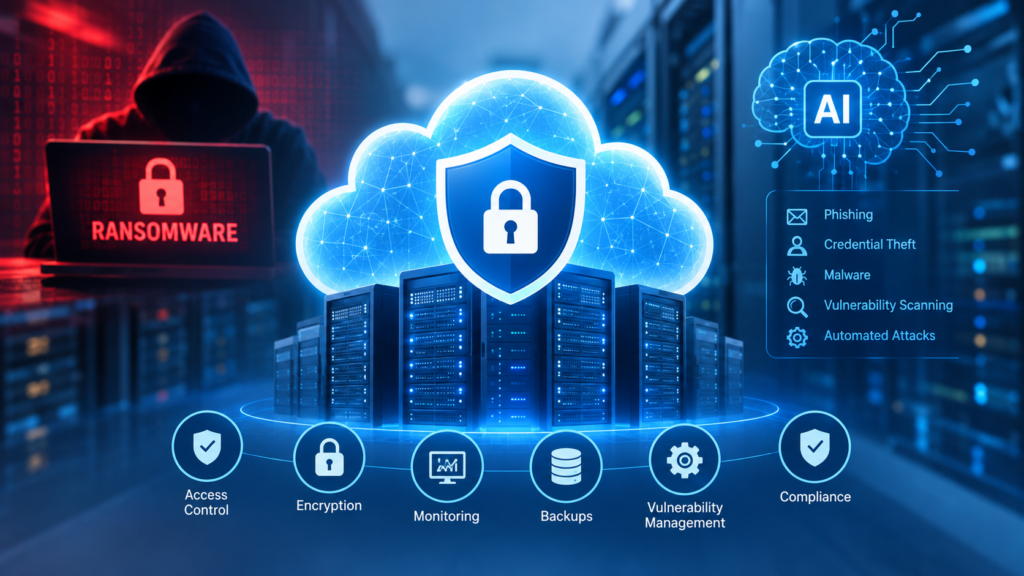
The Growing Threats Facing Cloud Server Security
Cloud computing has become the backbone of modern business operations. Organizations rely on cloud servers to store data, run applications, support remote workforces, and scale operations efficiently. However, as cloud adoption accelerates, cybercriminals are increasingly targeting cloud environments with sophisticated ransomware campaigns and AI-powered attacks.
The challenge for organizations is no longer whether they should move to the cloud, but how they can secure cloud infrastructure against rapidly evolving threats. Cloud server security has become a critical component of enterprise risk management, especially as ransomware groups and AI-enabled attackers exploit vulnerabilities faster than ever before.
According to IBM’s Cost of a Data Breach Report 2024, the global average cost of a data breach reached $4.88 million, marking a 10% increase over the previous year, while 70% of breached organizations reported significant operational disruption following an incident (IBM Cost of a Data Breach Report 2024).
Cloud Server Security in Modern Enterprises
Cloud server security refers to the technologies, policies, and processes used to protect cloud-hosted systems, applications, and data from unauthorized access, cyberattacks, and operational disruptions.
Unlike traditional on-premises environments, cloud infrastructure operates under a shared responsibility model. While cloud providers secure the underlying infrastructure, organizations remain responsible for protecting their data, user access, applications, and configurations.
Effective cloud server security typically includes:
- Identity and access management (IAM)
- Data encryption
- Security monitoring
- Vulnerability management
- Backup and disaster recovery planning
- Compliance and governance controls
As organizations expand across public cloud, private cloud, and hybrid environments, maintaining visibility and control becomes increasingly difficult. IBM reported that 40% of data breaches involved information spread across multiple environments, including public cloud, private cloud, and on-premises systems, making these incidents among the most expensive and time-consuming to contain (IBM Cost of a Data Breach Report 2024).
Why Ransomware Is a Growing Threat to Cloud Environments
Ransomware has evolved far beyond simple file encryption attacks. Today’s ransomware operators target cloud servers, backup repositories, and business-critical applications to maximize operational disruption and financial pressure.
Cloud environments are attractive targets because they often contain vast amounts of sensitive data and support essential business functions. If attackers gain access to cloud infrastructure, they can encrypt workloads, steal confidential information, and disrupt operations simultaneously.
Several factors contribute to the growing ransomware threat:
- Increased cloud adoption
- Weak access controls
- Misconfigured cloud resources
- Inadequate backup protections
- Stolen credentials
Recent threat intelligence findings show ransomware activity continues to rise significantly. Security researchers reported a fourfold increase in ransomware-related threats during 2024, driven largely by the expansion of Ransomware-as-a-Service (RaaS) operations (Barracuda Managed XDR Research 2025).
Modern ransomware groups also use double-extortion tactics, where data is stolen before encryption. Organizations face pressure not only to restore operations but also to prevent public exposure of sensitive information.
The Rise of AI-Powered Cyber Threats
Artificial intelligence is transforming cybersecurity for both defenders and attackers.
While AI helps organizations improve threat detection and incident response, cybercriminals are leveraging the same technologies to automate reconnaissance, craft convincing phishing campaigns, and identify vulnerabilities at scale.
AI-powered attacks can:
- Generate highly convincing phishing emails
- Automate credential theft campaigns
- Create realistic deepfake communications
- Identify exposed cloud assets
- Accelerate malware development
Recent research indicates that AI-related security incidents are becoming increasingly common. Check Point’s cloud security research found that 78% of businesses reported AI-related security incidents, highlighting the growing impact of AI on enterprise security operations (Check Point 2026 Cloud Security Report).
The emergence of generative AI has also significantly reduced the time required to prepare phishing attacks. Security researchers report that attackers can now create convincing phishing content in minutes rather than hours, increasing both the volume and effectiveness of social engineering campaigns.
Common Cloud Server Security Weaknesses Attackers Exploit
Despite advances in cloud security technologies, many successful attacks still result from basic security gaps rather than sophisticated exploits. Attackers often target common weaknesses that provide easy access to cloud environments.
Misconfigured Cloud Resources
Cloud misconfigurations remain a leading cause of security incidents. Publicly exposed storage buckets, excessive permissions, unsecured APIs, and open administrative interfaces can all create opportunities for attackers. According to Wiz, 80% of cloud breaches stem from basic mistakes such as misconfigurations, exposed credentials, and poor exposure management (Wiz Cloud Security Research 2026).
Weak Authentication Controls
Organizations that rely solely on passwords face increased risks from credential theft, account takeovers, and privilege escalation attacks. Multi-factor authentication (MFA) remains one of the most effective ways to strengthen cloud security, yet it is not consistently implemented across all environments.
Limited Visibility and Monitoring
Without effective monitoring, malicious activity can go undetected for extended periods. This allows attackers to move through systems, access sensitive data, and potentially deploy ransomware before security teams can respond.
Essential Cloud Server Security Best Practices
Organizations can reduce risk by adopting a layered cloud security strategy focused on prevention, detection, and recovery.
Implement Zero Trust Security
Zero Trust requires continuous verification of users and devices before granting access, helping reduce unauthorized activity and limit the impact of compromised accounts.
Strengthen Identity and Access Management
Strong IAM practices include enforcing MFA, applying least-privilege access, reviewing permissions regularly, and monitoring privileged accounts to prevent unauthorized access.
Encrypt Sensitive Data
Encrypting data at rest and in transit helps protect critical information and reduces the risk of exposure if systems are compromised.
Conduct Regular Security Assessments
Routine vulnerability scans, configuration reviews, and risk assessments help identify weaknesses before attackers can exploit them.
Maintain Reliable Backup and Recovery Plans
Secure, regularly tested backups enable organizations to recover more quickly from ransomware attacks and other disruptive security incidents.
How Cybersecurity and Data Security Consultants Strengthen Cloud Security
As cloud environments become more complex and cyber threats continue to evolve, many organizations struggle to maintain a strong security posture using internal resources alone. This is where both a cybersecurity consultant such as Dr Ondrej Krehel, provide significant value by helping businesses identify vulnerabilities, reduce risk, and build more resilient cloud security strategies.
An experienced cybersecurity consultant focuses on protecting cloud infrastructure by assessing security controls, evaluating risk exposure, improving incident response readiness, and ensuring cloud environments align with industry best practices. Through cloud security assessments, security architecture reviews, and compliance guidance, consultants help organizations strengthen their overall defense against ransomware, unauthorized access, and emerging cyber threats.
At the same time, a data security consultant concentrates on protecting the sensitive information stored within cloud environments. This includes developing data governance frameworks, implementing access control strategies, supporting regulatory compliance initiatives, and reducing the risk of data loss or unauthorized disclosure. As organizations increasingly store customer data, intellectual property, and regulated information in the cloud, effective data protection has become a critical business requirement.
Building a Resilient Cloud Security Strategy for the Future
The future of cloud security will be shaped by both technological innovation and evolving attacker capabilities.
Artificial intelligence is creating new opportunities for security automation and threat detection. IBM research found that organizations extensively using AI and automation in security operations reduced breach-related costs by an average of $2.2 million compared to organizations that did not use these technologies extensively (IBM Cost of a Data Breach Report 2024).
At the same time, AI is expanding the attack surface and introducing new security challenges. Organizations must therefore balance innovation with strong governance, visibility, and access controls.
A resilient cloud security strategy should integrate:
- People
- Processes
- Technology
- Governance
- Continuous improvement
Organizations that focus solely on technology often overlook the operational and human factors that contribute to security incidents.
Securing Cloud Servers Against Emerging Threats
Cloud server security has become a fundamental business requirement in an era defined by ransomware and AI-powered cyber threats. Attackers are increasingly targeting cloud environments because they contain valuable data, critical applications, and complex infrastructures that can be difficult to secure.
Many successful attacks result from preventable issues such as misconfigurations, weak authentication controls, and insufficient visibility rather than advanced technical exploits. Strengthening cloud security therefore requires a combination of robust technologies, effective governance, and continuous risk management.
A cybersecurity consultant USA can help organizations assess vulnerabilities, improve security architecture, and align defenses with business objectives, while a data security consultant can ensure sensitive information remains protected throughout its lifecycle.
As ransomware groups and AI-enabled attackers continue to evolve, organizations that invest in proactive cloud security strategies will be far better positioned to maintain resilience, protect critical assets, and reduce long-term cyber risk.
FAQs Section:
1. What is cloud server security?
Cloud server security refers to the technologies, policies, and practices used to protect cloud-based servers, applications, and data from cyber threats and unauthorized access.
2. Why are ransomware attacks a threat to cloud environments?
Ransomware can encrypt cloud-hosted data, disrupt critical operations, and lead to significant financial and reputational damage for organizations.
3. How do AI-powered threats affect cloud security?
AI-powered threats enable attackers to automate phishing campaigns, identify vulnerabilities faster, and launch more sophisticated cyberattacks at scale.
4. How can a cybersecurity consultant improve cloud security?
A cybersecurity consultant helps organizations assess risks, identify security gaps, strengthen defenses, and improve incident response capabilities.
5. What does a data security consultant do?
A data security consultant focuses on protecting sensitive information through data governance, access controls, compliance support, and data protection strategies.