
Why Fileless Malware Is Becoming A Silent Cybersecurity Risk
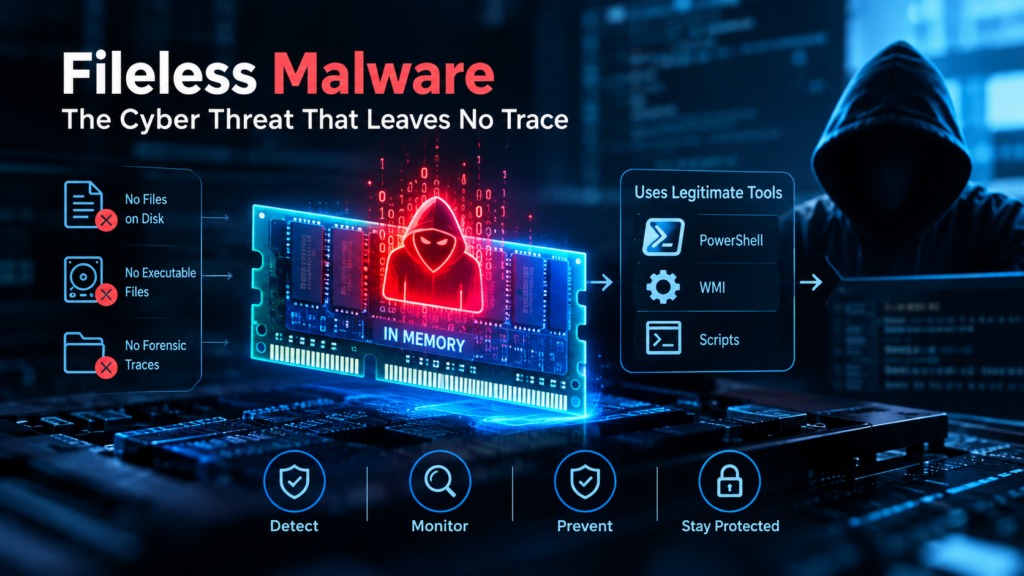
Fileless malware has emerged as one of the most dangerous modern cyber threats because it operates without leaving traditional forensic traces. Unlike conventional malware that relies on executable files stored on disk, fileless malware executes directly in memory, making it extremely difficult for traditional security tools to detect.
Cybercriminals are increasingly shifting toward stealth-based attacks. Modern research shows that a significant portion of enterprise intrusions now involve “malware-free” techniques, where attackers rely on legitimate system tools rather than malicious files. In fact, recent threat intelligence indicates that over 82% of modern attack detections involve malware-free or fileless techniques.
This evolution has made fileless malware a preferred method for advanced persistent threats (APT), ransomware deployment, and data theft operations. Organizations can no longer rely solely on signature-based antivirus tools.
A cybersecurity consultant or data security consultant is now often required to help organizations identify hidden attack paths and strengthen defensive architecture against these invisible threats.
What Is Fileless Malware?
Fileless malware is a type of malicious software that operates without installing files on a system’s hard drive. Instead, it executes directly in system memory (RAM), often using legitimate system tools.
Unlike traditional malware, which leaves behind artifacts such as executable files, fileless malware:
- Does not write files to disk
- Executes in memory
- Uses trusted system processes
- Often disappears after reboot
This makes detection extremely difficult for traditional antivirus tools.
Fileless techniques are commonly associated with living-off-the-land (LOTL) attacks, where attackers abuse legitimate tools like PowerShell, Windows Management Instrumentation (WMI), and scripting engines to execute malicious commands.
How Fileless Malware Works (Step-by-Step Attack Flow)
Fileless malware typically follows a multi-stage execution process designed to avoid detection.
| Stage | Description | What Happens in This Phase |
| 1. Initial Access | Entry point into the system | Attackers typically gain access through phishing emails, malicious links, or stolen credentials. This is often the first compromise in the attack chain. |
| 2. Execution via Trusted Tools | Abuse of legitimate system utilities | Instead of dropping files, attackers use built-in tools such as PowerShell or Windows scripting engines to execute malicious commands while avoiding detection. |
| 3. Memory-Based Payload Execution | Running malware in system memory | The malicious payload is executed directly in RAM without being written to disk, making it harder for traditional antivirus tools to detect. |
| 4. Lateral Movement & Data Theft | Expanding control and extracting data | Once inside, attackers move across the network, escalate privileges, and exfiltrate sensitive data or deploy ransomware. |
Key Insight
This attack method is highly effective because it blends into normal system activity, allowing it to remain largely invisible to traditional security monitoring tools and signature-based detection systems.
Why Fileless Malware Is So Hard to Detect
Fileless malware is extremely difficult to detect because it does not rely on traditional malicious files or obvious indicators of compromise. Instead, it operates in ways that closely resemble normal system activity, making it harder for security tools to identify suspicious behavior.
One of the main reasons it evades detection is that no malicious files are stored on disk. Attackers execute code directly in system memory, leaving little to no forensic evidence behind. In addition, fileless malware often uses legitimate system processes such as PowerShell or Windows management tools, which are normally trusted by security systems.
It is also designed to mimic standard administrative activity, allowing it to blend in with everyday IT operations. Because of this, signature-based antivirus tools which rely on identifying known malware files are often ineffective against these attacks.
Traditional antivirus solutions are increasingly limited in modern environments. Industry research indicates that conventional antivirus tools can fail to detect up to 40% of advanced attacks that use fileless or behavioral techniques.
As a result, many organizations are shifting toward behavioral-based detection methods and Endpoint Detection and Response (EDR) solutions, which focus on identifying unusual activity patterns rather than relying solely on file signatures.
Common Attack Vectors Used in Fileless Malware
Fileless malware does not rely on traditional file downloads or executable installations. Instead, it uses a combination of social engineering tactics and legitimate system tools to gain access and execute malicious actions within an environment. This makes it significantly harder to detect and block using conventional security controls.
Phishing and Social Engineering
One of the most common entry points is phishing. Attackers trick users into clicking malicious links, opening infected documents, or executing hidden scripts. In many cases, the user is unknowingly initiating the attack by interacting with what appears to be a legitimate email or message.
Malicious Macros in Documents
Office documents such as Word or Excel files are frequently weaponized with embedded macros. When enabled, these macros execute scripts that run malicious code directly in memory, often without creating any visible files on the system.
Compromised Credentials
Stolen or reused credentials are another major attack vector. Once attackers obtain valid login details, they can access cloud platforms, enterprise systems, and remote environments without triggering traditional malware alerts, making detection extremely difficult.
Living-off-the-Land (LOTL) Techniques
In many fileless attacks, cybercriminals use built-in system tools such as PowerShell, Windows Management Instrumentation (WMI), or command-line utilities to carry out malicious activities. Because these tools are legitimate and widely used by administrators, their misuse often goes unnoticed.
Overall, these attack methods are highly effective in enterprise environments because they blend seamlessly with normal user behavior and system operations, allowing attackers to remain undetected for extended periods while executing their objectives.
Real-World Impact of Fileless Malware
The impact of fileless malware is significant, particularly in enterprise environments where sensitive data and critical infrastructure are involved.
Common consequences include:
- Large-scale data breaches
- Ransomware deployment
- Financial fraud
- Intellectual property theft
- Long-term system compromise
Recent cybersecurity studies show that fileless and memory-based attacks are increasingly used in ransomware operations, with attackers prioritizing stealth before encryption. This allows them to remain undetected longer and maximize damage before triggering payload execution.
Detection & Prevention Techniques
Defending against fileless malware requires a shift from traditional antivirus to behavior-based security models.
Endpoint Detection and Response (EDR)
EDR tools monitor system behavior in real time and detect anomalies such as unusual script execution or memory manipulation.
Zero Trust Security Model
Zero Trust ensures that no user or device is automatically trusted, reducing unauthorized access risks.
Behavioral Threat Detection
Instead of relying on file signatures, behavioral systems analyze activity patterns.
Threat Hunting
Security teams actively search for hidden threats within networks.
Continuous Monitoring
Real-time monitoring ensures faster detection and response to suspicious activity.
These layered approaches significantly improve detection rates compared to traditional methods.
Cybersecurity and Data Security Consultants: A Unified Defense Against Fileless Malware
Fileless malware requires a defense strategy that goes beyond traditional security roles. A cybersecurity consultant and a data security consultant together form a critical layer of enterprise resilience.
A cybersecurity consultant such as Dr. Ondrej Krehel, focuses on identifying hidden system vulnerabilities, strengthening endpoint defenses, improving incident response readiness, and designing layered security architectures that reduce attack exposure.
A data security consultant complements this by protecting the most valuable asset data. This includes enforcing governance, strengthening access controls, ensuring compliance, and implementing data loss prevention strategies across cloud and hybrid environments.
Fileless malware thrives in memory-based execution environments, often bypassing conventional detection tools. A combined consulting approach ensures that even if systems are compromised, sensitive data remains protected and exposure is minimized.
This integrated model reflects modern cybersecurity leadership thinking where resilience is achieved through alignment of infrastructure security and data protection strategy.
Best Practices to Defend Against Fileless Malware
Organizations can significantly reduce risk by implementing a proactive security strategy.
Key best practices include:
- Enforcing multi-factor authentication (MFA)
- Restricting PowerShell and script execution
- Regularly patching systems
- Using application whitelisting
- Segmenting networks
- Conducting employee security training
These controls reduce the attack surface and limit opportunities for exploitation.
The Future of Cybersecurity Depends on Proactive Protection
Fileless malware represents a major shift in cyberattacks, where threats execute directly in memory and bypass traditional file-based detection. This makes conventional security tools less effective against modern intrusion techniques.
Most breaches today are driven not by advanced zero-day exploits, but by misconfigurations, weak identity controls, and limited system visibility that allow attackers to move undetected.
Defending against these threats requires a layered security approach that includes behavioral detection, continuous monitoring, and strong access management. At the center of this strategy, a cybersecurity consultant USA, plays a key role in identifying hidden risks and strengthening overall security posture.
Proactive defense is no longer optional it is essential for protecting against fast-evolving, memory-based cyber threats like fileless malware.
FAQs Section:
1. What is fileless malware?
Fileless malware is a type of cyberattack that runs directly in system memory without installing files on disk, making it difficult to detect.
2. Why is fileless malware dangerous?
It is dangerous because it bypasses traditional antivirus tools and blends into legitimate system processes, allowing attackers to remain undetected.
3. How does fileless malware spread?
It commonly spreads through phishing emails, malicious scripts, compromised credentials, and exploitation of trusted system tools.
4. Can traditional antivirus detect fileless malware?
Traditional antivirus solutions often struggle to detect fileless malware, which is why behavioral detection and EDR tools are more effective.
5. How can a cybersecurity consultant help prevent fileless malware?
A cybersecurity consultant helps identify security gaps, improve detection strategies, and design layered defenses to reduce the risk of fileless attacks.