
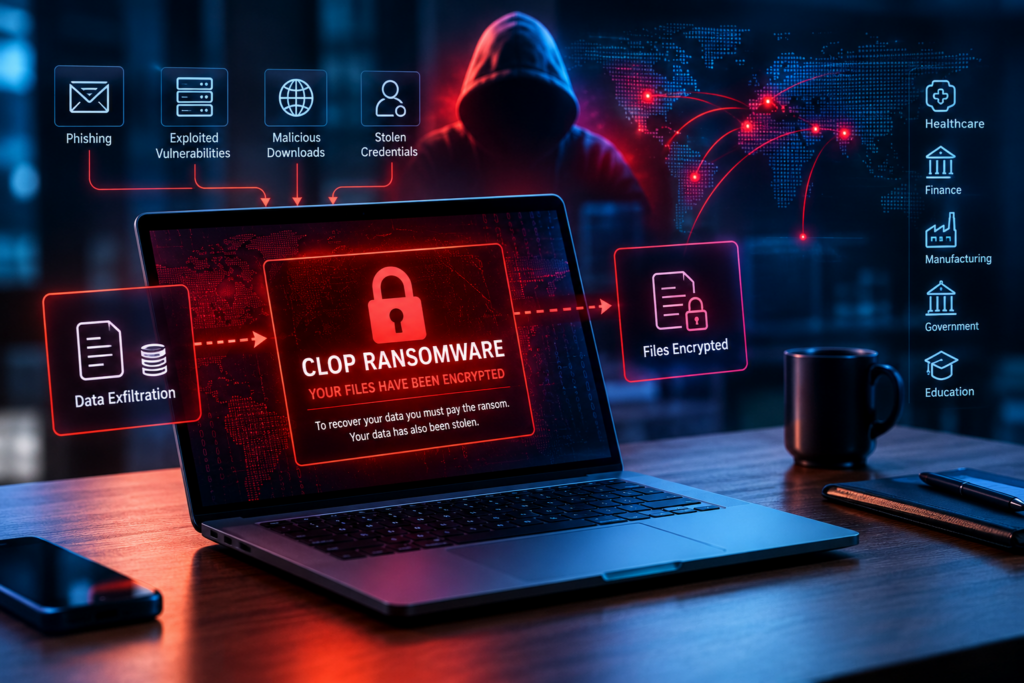
How Clop Ransomware Increases Enterprise Cyber Risk
Ransomware has evolved into one of the most disruptive cyber threats facing organizations today, with cybercriminal groups continuously refining their tactics to maximize financial gain. Among the most notorious is Clop ransomware, a sophisticated ransomware operation known for exploiting software vulnerabilities, stealing sensitive data, and using double-extortion techniques to pressure victims into paying substantial ransoms. Unlike traditional ransomware that focuses solely on encrypting files, Clop often exfiltrates confidential information before encryption, increasing the financial, legal, and reputational consequences of an attack.
The group’s high-profile campaigns have targeted organizations across healthcare, finance, manufacturing, education, government, and professional services, demonstrating that businesses of every size remain potential victims. As enterprises become increasingly reliant on cloud services, third-party software, and interconnected supply chains, defending against ransomware has become a strategic business priority.
According to the Verizon 2025 Data Breach Investigations Report, ransomware continues to be one of the most common attack patterns in data breaches, while organizations worldwide continue to experience increasing financial and operational disruption from ransomware campaigns.
Building resilience against threats like Clop requires proactive security strategies, continuous monitoring, and guidance from an experienced cybersecurity consultant who understands today’s rapidly evolving threat landscape.
What Is Clop Ransomware?
Clop ransomware (also written as Cl0p) is a sophisticated ransomware operation associated with a well-organized cybercriminal group that targets businesses through data theft, ransomware deployment, and large-scale extortion campaigns. The group has gained global attention for exploiting vulnerabilities in widely used enterprise software, allowing attackers to compromise multiple organizations simultaneously.
Unlike many traditional ransomware families, Clop frequently uses a double-extortion model. Before encrypting files, attackers steal sensitive business information and threaten to publish or sell the data if victims refuse to pay the ransom. This tactic significantly increases pressure on organizations by combining operational disruption with the risk of regulatory penalties and reputational damage.
Clop has also demonstrated the ability to exploit zero-day vulnerabilities, particularly in managed file transfer platforms such as MOVEit Transfer, enabling attackers to compromise organizations without relying solely on phishing or credential theft.
Industries commonly targeted include:
- Financial services
- Healthcare
- Manufacturing
- Retail
- Government agencies
- Professional services
- Educational institutions
Because Clop targets organizations that manage valuable data and complex supply chains, even a single successful compromise can affect thousands of customers, partners, and vendors.
How Clop Ransomware Attacks Work
Clop ransomware campaigns typically follow a structured attack lifecycle designed to maximize both operational disruption and financial leverage.
Initial Access
Attackers gain entry using multiple techniques, including phishing emails, stolen credentials, exploited zero-day vulnerabilities, and internet-facing applications with unpatched security flaws. In recent campaigns, Clop operators have heavily exploited vulnerabilities in managed file transfer software to compromise organizations on a large scale.
Privilege Escalation and Lateral Movement
Once inside the environment, attackers attempt to obtain administrative privileges and move laterally across networks. This allows them to identify valuable systems, disable security tools, and gain access to sensitive business information before launching the ransomware payload.
Data Exfiltration
Prior to encryption, Clop operators quietly collect confidential documents, customer information, financial records, intellectual property, and other sensitive data. Exfiltrated information becomes a powerful tool for extortion, even if organizations can restore encrypted systems from backups.
File Encryption
After stealing data, attackers encrypt critical systems, servers, and workstations, preventing employees from accessing essential business applications and operational data. Encryption often disrupts normal business activities, leading to downtime and significant productivity losses.
Extortion and Negotiation
Victims receive ransom demands instructing them to pay for decryption keys while also being threatened with public disclosure of stolen information. This double-extortion strategy places organizations under intense financial and reputational pressure, particularly when regulated or customer data is involved.
Business Risks of Clop Ransomware
Clop ransomware creates consequences that extend far beyond encrypted files. Modern ransomware attacks can disrupt operations, expose sensitive information, damage customer trust, and create lasting financial and regulatory challenges.
Operational Downtime
Encrypted systems may prevent employees from accessing business-critical applications, delaying operations and interrupting customer services. Even organizations with reliable backups often require significant time to fully restore operations.
Data Theft
Because Clop steals information before encryption, organizations face the additional risk of confidential business records, intellectual property, employee information, and customer data being publicly exposed or sold to other cybercriminals.
Financial Losses
Recovery expenses frequently include forensic investigations, legal services, regulatory reporting, business interruption, infrastructure restoration, customer notification, and cybersecurity improvements. These costs often exceed the ransom demand itself.
According to IBM’s Cost of a Data Breach Report 2024, the global average cost of a data breach reached USD 4.88 million, the highest average ever recorded, demonstrating the growing financial impact of cyber incidents. (Source: IBM Cost of a Data Breach Report 2024)
Regulatory and Compliance Risks
Organizations subject to regulations such as GDPR, HIPAA, and PCI DSS may face investigations, compliance penalties, and legal action if attackers expose regulated information during a ransomware attack.
Reputational Damage
Loss of customer trust can have long-term business consequences. Public disclosure of sensitive information may affect client relationships, investor confidence, and future business opportunities, even after technical recovery is complete.
As ransomware groups continue refining their tactics, organizations must adopt proactive cybersecurity strategies that reduce exposure, strengthen resilience, and prepare for increasingly sophisticated attacks.
Detecting Clop Ransomware Before It Spreads
Early detection is essential for limiting the impact of Clop ransomware. Because attackers often spend time inside a network before encrypting files, organizations should focus on identifying suspicious activity during the initial stages of an attack.
Common warning signs include unusual authentication attempts, unexpected privilege escalation, abnormal outbound network traffic, unauthorized access to file transfer systems, suspicious endpoint behavior, and large volumes of data being transferred outside the network. Security technologies such as Endpoint Detection and Response (EDR), Extended Detection and Response (XDR), Security Information and Event Management (SIEM), and threat intelligence platforms help identify these indicators before ransomware spreads. If malicious activity is detected, organizations should immediately isolate affected systems, activate their incident response plan, preserve forensic evidence, and begin recovery using verified backups.
Best Practices for Preventing Clop Ransomware
Preventing Clop ransomware requires a proactive, layered cybersecurity strategy that reduces opportunities for attackers to gain access and move across enterprise environments.
Organizations should prioritize prompt vulnerability management by applying security patches to operating systems, internet-facing applications, and third-party software as soon as updates become available. Strong identity security is equally important. Implementing Identity and Access Management (IAM), enforcing Multi-Factor Authentication (MFA), and adopting Zero Trust principles help prevent unauthorized access through compromised credentials.
Businesses should also deploy EDR and XDR solutions, encrypt sensitive information, maintain secure offline backups, and regularly test disaster recovery procedures. Continuous employee security awareness training remains critical, particularly for defending against phishing attacks and social engineering. According to the Verizon 2025 Data Breach Investigations Report, human involvement continues to play a significant role in security breaches, highlighting the importance of combining technical controls with ongoing user education.
How a Cybersecurity Consultant and Data Security Consultant Strengthen Ransomware Defense
Protecting organizations from sophisticated ransomware campaigns requires strategic planning as well as technical expertise. An experienced cybersecurity consultant, such as Dr. Ondrej Krehel, helps organizations assess ransomware risks, identify security gaps, strengthen network and cloud security, implement Zero Trust architectures, and develop incident response strategies that improve cyber resilience.
A data security consultant complements these efforts by protecting sensitive information throughout its lifecycle. This includes establishing data governance policies, implementing encryption, deploying Data Loss Prevention (DLP) solutions, securing backup environments, and aligning security controls with regulatory frameworks such as GDPR, HIPAA, and PCI DSS. Together, these capabilities reduce the likelihood of successful ransomware attacks while minimizing operational disruption and regulatory exposure.
Future Trends in Ransomware
Ransomware continues to evolve as cybercriminals adopt more advanced tools and attack techniques. Artificial intelligence, automation, and cloud technologies are enabling attackers to identify vulnerable systems more quickly while increasing the scale and sophistication of ransomware campaigns.
Emerging trends include:
- AI-assisted ransomware and automated attack workflows.
- Greater exploitation of software supply chain vulnerabilities.
- Increased targeting of cloud environments and SaaS platforms.
- More identity-based attacks using stolen credentials.
- Continued growth of double- and triple-extortion tactics.
- Expanded use of behavioral analytics and AI-powered threat detection by security teams.
Organizations that continuously assess cyber risk, strengthen identity security, and maintain resilient recovery capabilities will be better prepared to respond to future ransomware threats.
Building Resilience Against Clop Ransomware
Clop ransomware demonstrates how modern ransomware has evolved beyond simple file encryption into a sophisticated cybercrime model focused on data theft, extortion, and business disruption. As organizations become more connected through cloud services, third-party software, and digital supply chains, the potential impact of these attacks continues to grow.
Reducing ransomware risk requires a layered cybersecurity strategy that combines vulnerability management, strong identity controls, continuous monitoring, secure backups, and employee awareness. Preparation before an attack is far more effective and less costly than recovery afterward.
Partnering with an experienced cybersecurity consultant USA helps organizations strengthen their overall security posture, improve incident response, and reduce cyber risk. At the same time, a data security consultant ensures sensitive business information remains protected through governance, encryption, and compliance, enabling organizations to build long-term resilience against evolving ransomware threats.
FAQs Section:
1. What is Clop ransomware?
Clop ransomware is a sophisticated ransomware operation that steals sensitive data and encrypts systems, using double-extortion tactics to pressure organizations into paying a ransom.
2. How does Clop ransomware spread?
Clop commonly exploits software vulnerabilities, phishing campaigns, stolen credentials, and internet-facing applications to gain unauthorized access to enterprise environments.
3. Which industries are most affected by Clop ransomware?
Healthcare, financial services, manufacturing, retail, government, education, and professional services are among the sectors most frequently targeted due to the value of their data.
4. How can businesses prevent Clop ransomware attacks?
Organizations should promptly patch vulnerabilities, implement IAM and MFA, adopt Zero Trust security, deploy EDR/XDR solutions, maintain offline backups, and provide regular employee security awareness training.
5. Why should organizations work with a cybersecurity consultant?
A cybersecurity consultant helps identify security gaps, strengthen ransomware defenses, improve incident response, and build long-term cyber resilience, while a data security consultant safeguards sensitive information through encryption, governance, and compliance.