
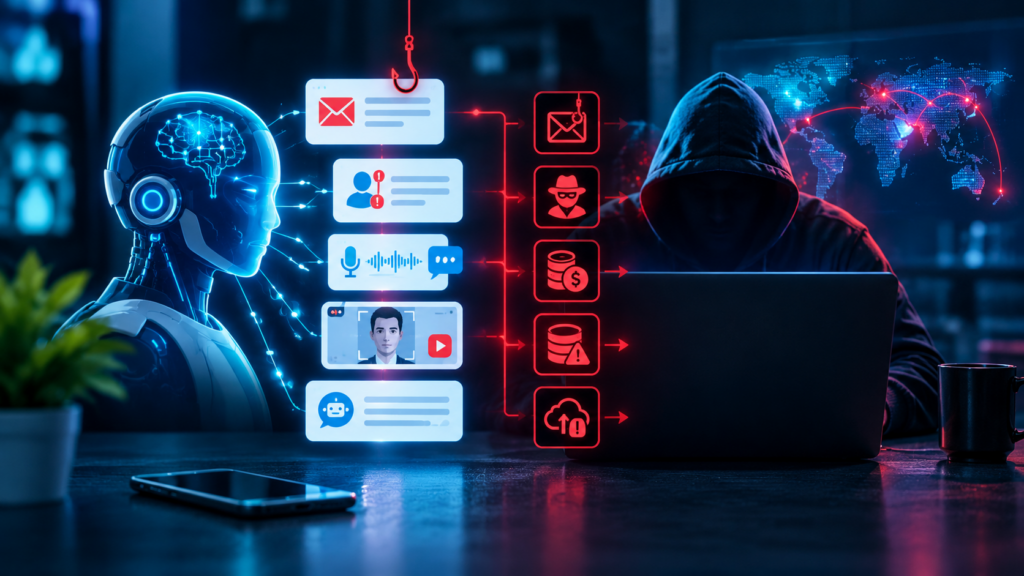
How AI Is Fueling Automated Cyber Fraud
Artificial intelligence has transformed the way organizations operate, but it has also reshaped the cyber threat landscape. Today, cybercriminals use AI, automation, and readily available cybercrime tools to launch phishing campaigns, impersonation attacks, credential theft, and financial fraud on an unprecedented scale. Rather than manually targeting individual victims, attackers can automate entire scam campaigns, enabling them to reach thousands of organizations in minutes while continuously adapting their techniques to evade detection.
This shift has given rise to scam automation the use of AI-powered tools, bots, and automated workflows to conduct cyber fraud with greater speed, accuracy, and scale. Businesses across every industry now face increasingly sophisticated attacks that exploit both technological vulnerabilities and human behavior.
According to the FBI Internet Crime Report 2024, reported cybercrime losses exceeded $16.6 billion in 2024, with phishing, business email compromise (BEC), investment fraud, and other online scams remaining among the most financially damaging cybercrimes.
As automated cyber threats continue to evolve, organizations must strengthen their cybersecurity strategies with layered defenses and expert guidance from an experienced cybersecurity consultant to reduce cyber risk and protect critical business assets.
What Is Scam Automation?
Scam automation refers to the use of artificial intelligence, machine learning, bots, and automated software to execute cyber scams with minimal human intervention. Instead of manually creating phishing emails or impersonating victims one at a time, attackers automate every stage of the attack lifecycle from identifying potential targets to delivering fraudulent messages and collecting stolen credentials.
Unlike traditional cyber scams, which often rely on repetitive manual effort, automated scams leverage AI to personalize messages, mimic legitimate communications, generate convincing emails, clone voices, and even adapt responses during conversations. This significantly increases both the efficiency and success rate of cybercriminal operations.
Common objectives of scam automation include:
- Stealing login credentials
- Conducting financial fraud
- Deploying malware
- Hijacking business accounts
- Collecting sensitive customer information
- Bypassing traditional security controls
As generative AI becomes more accessible, even less-experienced attackers can create highly convincing scam campaigns, making automated fraud one of the fastest-growing cybersecurity challenges facing modern businesses.
How Scam Automation Works
Modern scam automation combines artificial intelligence with automation platforms to execute cyberattacks at scale. Although attack techniques vary, most automated scam campaigns follow a similar process.
AI-Powered Target Identification
The process begins by gathering publicly available information from company websites, social media platforms, leaked databases, and previous data breaches. AI systems analyze this information to identify executives, employees, customers, suppliers, and business relationships that can be exploited during future attacks.
By automating reconnaissance, cybercriminals significantly reduce the time required to identify high-value targets while improving the accuracy of personalized attacks.
Automated Phishing and Social Engineering
After identifying potential victims, AI generates personalized phishing emails, SMS messages, and social media communications that closely resemble legitimate business correspondence. Advanced language models can imitate writing styles, company branding, and even ongoing conversations, making fraudulent communications increasingly difficult to recognize.
Automated systems can distribute thousands of phishing messages simultaneously while continuously modifying subject lines, wording, and sender identities to avoid spam filters and security controls.
Credential Theft and Account Takeover
Once victims interact with malicious links or fake login portals, automated systems collect usernames, passwords, session cookies, authentication tokens, and other sensitive information. Attackers can immediately test stolen credentials across multiple cloud services, email platforms, and enterprise applications to identify successful logins.
This rapid automation allows cybercriminals to compromise business accounts before organizations have time to detect suspicious activity.
Malware Delivery and Financial Fraud
Many automated scams also distribute malware through malicious attachments, fake software updates, or compromised websites. Once access is established, attackers may deploy ransomware, banking trojans, remote access tools, or spyware while simultaneously initiating fraudulent financial transactions or stealing confidential business data.
Automation enables multiple attack stages to occur simultaneously, increasing both the speed and financial impact of cyber incidents.
Continuous Adaptation Using AI
One of the most concerning aspects of scam automation is its ability to adapt. AI-powered systems continuously analyze campaign performance, identify successful attack techniques, and modify future attacks based on victim responses. This ongoing optimization allows cybercriminals to improve success rates while bypassing traditional signature-based security tools.
Common Types of Scam Automation
Cybercriminals are using automation across a wide variety of fraud schemes, many of which specifically target organizations and their employees.
AI-Generated Phishing Emails
Generative AI enables attackers to create highly convincing phishing emails with accurate grammar, personalized content, and realistic branding. These messages often impersonate trusted organizations, executives, financial institutions, or software providers to steal credentials or distribute malware.
Business Email Compromise (BEC)
Business Email Compromise attacks increasingly leverage AI to impersonate executives, vendors, or business partners. Automated systems analyze communication patterns before generating fraudulent payment requests or invoice scams that appear legitimate.
According to the FBI Internet Crime Report 2024, Business Email Compromise remained one of the highest-loss cybercrime categories, causing billions of dollars in reported losses.
SMS Phishing (Smishing) and Voice Phishing (Vishing)
Automated SMS campaigns distribute fraudulent delivery notifications, banking alerts, password reset requests, and account verification messages designed to lure victims into revealing sensitive information. AI-powered voice cloning has also enhanced vishing attacks by allowing cybercriminals to imitate executives, employees, or family members with alarming realism.
Deepfake and AI Impersonation Scams
Deepfake technology enables attackers to generate convincing audio and video impersonations of trusted individuals. These attacks may be used to authorize fraudulent financial transfers, bypass identity verification processes, or manipulate employees into disclosing confidential information.
Chatbot and Customer Support Impersonation
Cybercriminals increasingly deploy AI chatbots that impersonate legitimate customer service representatives. These automated conversations can persuade victims to install malicious software, share authentication codes, or disclose payment information while maintaining realistic interactions throughout the conversation.
Business Risks of Scam Automation
Scam automation presents significant risks for organizations because it combines automation, artificial intelligence, and social engineering to target both technology and people. Successful attacks can result in financial losses, operational disruption, stolen intellectual property, regulatory penalties, and long-term reputational damage.
Credential theft remains one of the most immediate risks, allowing attackers to access email systems, cloud platforms, financial applications, and sensitive business data. Automated scams also increase the likelihood of data breaches, exposing confidential customer information and triggering costly compliance obligations.
Organizations may also suffer business interruption when automated attacks distribute ransomware or compromise critical systems. In addition to direct financial losses, these incidents often erode customer trust and damage long-term brand reputation.
According to the IBM Cost of a Data Breach Report 2024, organizations experienced an average data breach cost of $4.88 million, highlighting the growing financial consequences of modern cyber threats.
Understanding these risks is the first step toward building an effective defense against increasingly sophisticated automated cyber scams.
How Businesses Can Defend Against Scam Automation
As scam automation becomes more sophisticated, organizations must adopt a proactive, layered security strategy. No single technology can stop every AI-driven attack, so businesses should combine technical controls, security policies, and employee awareness to reduce cyber risk.
Employee education remains one of the most effective defenses. Regular security awareness training helps employees recognize phishing emails, suspicious links, deepfake impersonations, and other forms of AI-powered social engineering before they lead to security incidents.
Organizations should also strengthen identity security by enforcing Multi-Factor Authentication (MFA) and implementing Identity and Access Management (IAM) based on the principle of least privilege. Even if attackers obtain login credentials, additional authentication measures can significantly reduce the likelihood of unauthorized access.
Modern security technologies further improve resilience. Endpoint Detection and Response (EDR), Extended Detection and Response (XDR), and Security Information and Event Management (SIEM) platforms continuously monitor endpoints, networks, and cloud environments for suspicious behavior. Combined with threat intelligence and behavioral analytics, these tools enable security teams to detect automated attacks before they spread across the organization.
Organizations should also implement Zero Trust security, secure email gateways, data encryption, and regular vulnerability assessments to reduce attack surfaces and protect sensitive business information.
According to the Verizon 2025 Data Breach Investigations Report, credential abuse and phishing remain among the most common initial access methods in data breaches, reinforcing the importance of strong identity protection and employee awareness.
How a Cybersecurity Consultant and Data Security Consultant Help Prevent Scam Automation
Combating AI-driven cyber fraud requires more than deploying security software. Organizations benefit from a comprehensive security strategy developed by experienced professionals who understand today’s evolving threat landscape.
A cybersecurity consultant, such as Dr. Ondrej Krehel, helps businesses identify security gaps, assess cyber risk, strengthen email security, improve identity protection, and implement layered security architectures designed to resist automated cyberattacks. Consultants also assist with incident response planning, vulnerability assessments, security governance, and Zero Trust implementation, enabling organizations to respond more effectively when attacks occur.
A data security consultant focuses on protecting sensitive business information throughout its lifecycle. This includes implementing Data Loss Prevention (DLP) solutions, encrypting confidential data, strengthening access controls, developing secure backup strategies, and ensuring compliance with regulations such as GDPR, HIPAA, and PCI DSS.
Together, these specialized services reduce the likelihood of successful scam automation campaigns while helping organizations maintain regulatory compliance, protect customer trust, and strengthen long-term cyber resilience.
Staying Ahead of Automated Cyber Fraud
Scam automation is transforming cybercrime by enabling attackers to launch highly targeted phishing campaigns, impersonation attacks, credential theft, and financial fraud at unprecedented speed and scale. As artificial intelligence continues to evolve, organizations must recognize that traditional security measures alone are no longer sufficient.
Reducing cyber risk requires a comprehensive strategy that combines employee awareness, identity protection, Zero Trust security, continuous monitoring, advanced threat detection, and effective incident response planning. These measures help organizations detect threats earlier, minimize operational disruption, and protect critical business assets.
Partnering with an experienced cybersecurity consultant USA enables organizations to strengthen their security posture, identify vulnerabilities, and develop proactive defense strategies against AI-driven cyber threats.
FAQs Section:
1. What is scam automation?
Scam automation is the use of artificial intelligence, bots, and automated software to conduct phishing, fraud, impersonation, credential theft, and other cyber scams with minimal human involvement.
2. How does AI improve cyber scams?
AI enables attackers to create personalized phishing emails, generate realistic deepfake audio and video, automate conversations, identify high-value targets, and continuously adapt attacks to improve their success rates.
3. What industries are most affected by scam automation?
Financial services, healthcare, government, retail, manufacturing, technology, and education are among the sectors most frequently targeted because they manage valuable data and financial transactions.
4. How can businesses defend against scam automation?
Organizations should implement employee awareness training, Multi-Factor Authentication (MFA), Identity and Access Management (IAM), Zero Trust security, EDR, XDR, SIEM, threat intelligence, secure email gateways, and continuous security monitoring.
5. Why should organizations work with a cybersecurity consultant?
A cybersecurity consultant helps organizations assess cyber risk, improve security architecture, implement effective defenses, and strengthen incident response. A data security consultant complements these efforts by protecting sensitive information through encryption, governance, compliance, and data protection best practices.