
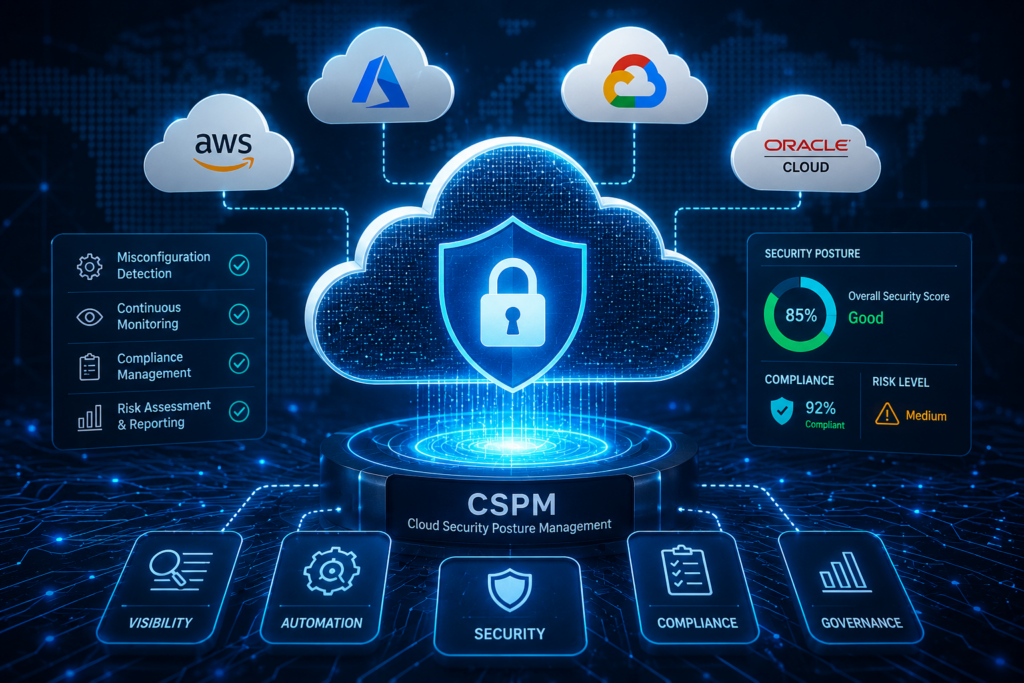
The Rising Challenges of Securing Multi-Cloud Environments
Organizations are rapidly adopting multi-cloud and hybrid cloud strategies to improve scalability, flexibility, and operational efficiency. While this shift enables innovation, it also introduces significant security challenges. Managing multiple cloud providers, each with its own configurations and policies, creates complexity that traditional security models struggle to address.
One of the biggest risks in cloud environments is misconfiguration. According to IBM, misconfigured cloud settings are responsible for a significant percentage of data breaches, contributing to the global average data breach cost of $4.45 million in 2023 (IBM, 2023). As cloud infrastructures expand, maintaining visibility and control becomes increasingly difficult.
This is where Cloud Security Posture Management (CSPM) plays a critical role. From a cybersecurity consultant’s perspective, CSPM is essential for proactively identifying risks, ensuring compliance, and maintaining a strong security posture across dynamic cloud environments.
What Is Cloud Security Posture Management (CSPM)?
Cloud Security Posture Management (CSPM) is a set of tools and practices designed to continuously monitor cloud environments, identify misconfigurations, and enforce security policies. CSPM solutions provide visibility into cloud assets, helping organizations detect vulnerabilities before they are exploited.
Unlike traditional security tools that focus on perimeter defense, CSPM operates within the cloud environment itself. It evaluates configurations, access controls, and compliance settings to ensure that systems are secure by design.
A data security consultant often relies on CSPM to ensure that sensitive data stored in the cloud is protected through proper configuration, encryption, and access management.
Related: Synthetic Identity Fraud In 2026: A Growing Challenge For Cybersecurity
Why CSPM Is Critical for Multi-Cloud Environments
Multi-cloud adoption has become a standard strategy for modern enterprises seeking flexibility, scalability, and resilience. However, this architectural approach significantly increases security complexity. Each cloud provider operates with its own configurations, security controls, and management interfaces, making it difficult to maintain consistent security policies across environments.
This fragmentation introduces several critical challenges, including limited centralized visibility across platforms, a higher likelihood of misconfigurations, difficulty enforcing uniform compliance standards, and increasingly complex identity and access management requirements.
These risks are not theoretical. According to Gartner, over 99% of cloud security failures will be the customer’s fault due to misconfigurations by 2025 (Gartner, 2023). This statistic highlights how small configuration errors can lead to significant security exposures in cloud environments.
Cloud Security Posture Management (CSPM) addresses these issues by providing centralized visibility and continuous monitoring across all cloud platforms. It enables organizations to detect misconfigurations, assess risks in real time, and remediate vulnerabilities before they can be exploited, significantly improving overall cloud security posture.
Related: Cloud Data Security: Best Practices To Protect Enterprise Data In 2026
Key Features of CSPM Solutions
CSPM tools offer a range of features that help organizations maintain a strong cloud security posture.
Misconfiguration Detection and Remediation
CSPM solutions continuously scan cloud environments to identify misconfigurations, such as publicly exposed storage or weak access controls. Automated remediation capabilities allow organizations to fix issues quickly, reducing exposure.
Continuous Monitoring
Real-time monitoring ensures that any changes in cloud configurations are immediately detected. This is critical in dynamic environments where resources are constantly being created and modified.
Compliance Management
CSPM tools help organizations align with regulatory frameworks such as GDPR, CIS benchmarks, and NIST guidelines. Automated compliance checks reduce the burden of manual audits.
Risk Assessment and Reporting
By analyzing vulnerabilities and misconfigurations, CSPM provides actionable insights that help organizations prioritize security efforts based on risk levels.
Related: Medusa Ransomware: How This Threat Is Targeting Modern Enterprises
Common Cloud Security Risks CSPM Addresses
Cloud environments introduce unique risks that require specialized solutions. CSPM is designed to mitigate these risks effectively.
One of the most common issues is misconfigured storage, where sensitive data is unintentionally exposed to the public. Similarly, excessive permissions in identity and access management (IAM) systems can allow unauthorized users to access critical resources.
Other risks include:
- Unsecured APIs that expose backend systems
- Shadow IT, where unauthorized cloud services are used without oversight
- Lack of encryption for data at rest or in transit
These vulnerabilities can be exploited quickly, making continuous monitoring essential.
Related: Blackcat Ransomware: Attack Methods, Risks, And Defense Strategies
Role of a Cybersecurity Consultant in CSPM Implementation
Implementing CSPM effectively requires expertise in cloud architecture and security best practices. A cybersecurity consultant like Dr Ondrej Krehel plays a crucial role in evaluating an organization’s cloud environment and identifying potential risks.
The process typically begins with a comprehensive security assessment, followed by the selection and deployment of appropriate CSPM tools. Consultants ensure that these tools are properly configured and integrated with existing systems such as SIEM and IAM platforms.
A data security consultant focuses on protecting sensitive information by enforcing encryption policies, access controls, and data governance frameworks. This ensures that data remains secure even in complex multi-cloud environments.
Ongoing monitoring and optimization are also critical. As cloud environments evolve, CSPM configurations must be updated to address new risks and maintain compliance.
Related: Could Mythos AI Threaten Banks? Emerging AI-Driven Cyber Risks
CSPM in Cloud and DevSecOps Environments
Modern organizations are increasingly adopting DevSecOps practices, integrating security into the development lifecycle. CSPM plays a key role in this process by providing automated security checks during development and deployment.
By integrating CSPM with DevOps pipelines, organizations can:
- Identify vulnerabilities before applications are deployed
- Enforce security policies in real time
- Reduce the risk of introducing misconfigurations into production environments
CSPM also supports container and Kubernetes security, ensuring that cloud-native applications are protected throughout their lifecycle.
CSPM vs Traditional Cloud Security Approaches
| Aspect | Traditional Cloud Security Approaches | Cloud Security Posture Management (CSPM) |
| Security Approach | Reactive, based on manual audits and periodic reviews | Proactive, continuous monitoring and automated enforcement |
| Threat Detection | Issues identified after audits or incidents occur | Real-time risk detection across cloud environments |
| Monitoring Method | Manual and often inconsistent | Automated and continuous monitoring |
| Remediation | Manual fixes after vulnerabilities are discovered | Proactive and often automated remediation capabilities |
| Visibility | Limited, fragmented across systems and providers | Centralized visibility across multi-cloud environments |
| Effectiveness in Cloud Environments | Struggles with dynamic and fast-changing infrastructure | Designed specifically for dynamic, scalable cloud environments |
| Security Outcome | Higher risk of delayed response and breaches | Improved prevention and reduced attack surface |
Best Practices for Implementing CSPM
Maximizing the effectiveness of Cloud Security Posture Management (CSPM) requires a structured approach that ensures continuous protection and visibility across cloud environments. Organizations should prioritize continuous monitoring to detect configuration changes and security risks in real time, allowing for faster identification of potential threats.
Another critical practice is enforcing the principle of least privilege access, which ensures that users and systems only have the minimum level of access required to perform their tasks, significantly reducing the risk of unauthorized access or privilege misuse.
To enhance visibility and threat correlation, CSPM should be integrated with Security Information and Event Management (SIEM) and Identity and Access Management (IAM) systems. This integration enables a more unified security view across the entire infrastructure.
Automation also plays a key role in modern cloud security. By automating remediation processes, organizations can reduce response times and address vulnerabilities before they are exploited. Additionally, regular compliance checks are essential to ensure alignment with regulatory frameworks and industry standards.
Together, these practices help organizations maintain a strong, consistent, and scalable security posture across complex multi-cloud environments.
Related: Top IAM Strategies To Strengthen Cybersecurity In 2026
Emerging Trends in Cloud Security Posture Management (2026)
As cloud security continues to evolve, several trends are shaping the future of CSPM.
AI-Driven Security Analytics
Artificial intelligence is being used to analyze large volumes of data and detect anomalies more effectively.
CNAPP Platforms
Cloud-Native Application Protection Platforms (CNAPP) are emerging as integrated solutions that combine CSPM with other cloud security tools.
Increased Automation
Automation is becoming essential for managing complex cloud environments, reducing the need for manual intervention.
Focus on Cloud-Native Security
Organizations are prioritizing security solutions designed specifically for cloud-native architectures.
According to Flexera, 87% of organizations have a multi-cloud strategy (Flexera, 2023), reinforcing the need for advanced tools like CSPM to manage security effectively.
Related: What Is A Security Operations Center (SOC): How It Protects Your Business From Cyber Threats
Strengthening Multi-Cloud Security with CSPM
As organizations continue to expand their cloud footprint, maintaining a strong security posture becomes increasingly complex. Multi-cloud environments introduce layered challenges that require not only advanced tools but also strategic oversight guided by a cybersecurity consultant USA, such as Dr. Ondrej Krehel, to ensure risks are properly identified and managed.
Cloud Security Posture Management provides the visibility, automation, and control needed to secure modern cloud infrastructures. With continuous monitoring of configurations, enforcement of compliance standards, and proactive vulnerability management, CSPM helps organizations reduce exposure and prevent costly security incidents.
In 2026, adopting CSPM is no longer just a recommended best practice—it has become a critical requirement for organizations aiming to protect sensitive data, maintain regulatory compliance, and build resilient, scalable cloud environments.
FAQs Section:
1. What is Cloud Security Posture Management (CSPM)?
CSPM is a set of tools and practices used to monitor cloud environments, detect misconfigurations, and enforce security policies.
2. Why is CSPM important for multi-cloud environments?
It provides centralized visibility and helps manage security risks across multiple cloud platforms.
3. What risks does CSPM help mitigate?
CSPM addresses misconfigurations, excessive permissions, unsecured APIs, and compliance issues.
4. How does CSPM improve cloud security?
It enables continuous monitoring, automated remediation, and proactive risk management.
5. Do businesses need a cybersecurity consultant for CSPM implementation?
Yes, expert guidance helps ensure proper deployment, integration, and optimization of CSPM solutions.