
AI Hallucinations Are Becoming a Major Security Concern
Artificial intelligence is rapidly transforming modern business operations. Organizations across healthcare, finance, cybersecurity, legal services, and customer support increasingly rely on generative AI systems to automate workflows, analyze data, improve productivity, and support decision-making processes. While these technologies offer significant operational advantages, they also introduce new cybersecurity and data integrity risks.
One of the most serious emerging concerns in 2026 is the growing problem of AI hallucinations. AI hallucinations occur when Large Language Models (LLMs) generate inaccurate, misleading, or entirely fabricated outputs while presenting them as factual information. Because generative AI systems are designed to respond confidently and conversationally, hallucinated responses can appear highly convincing to users.
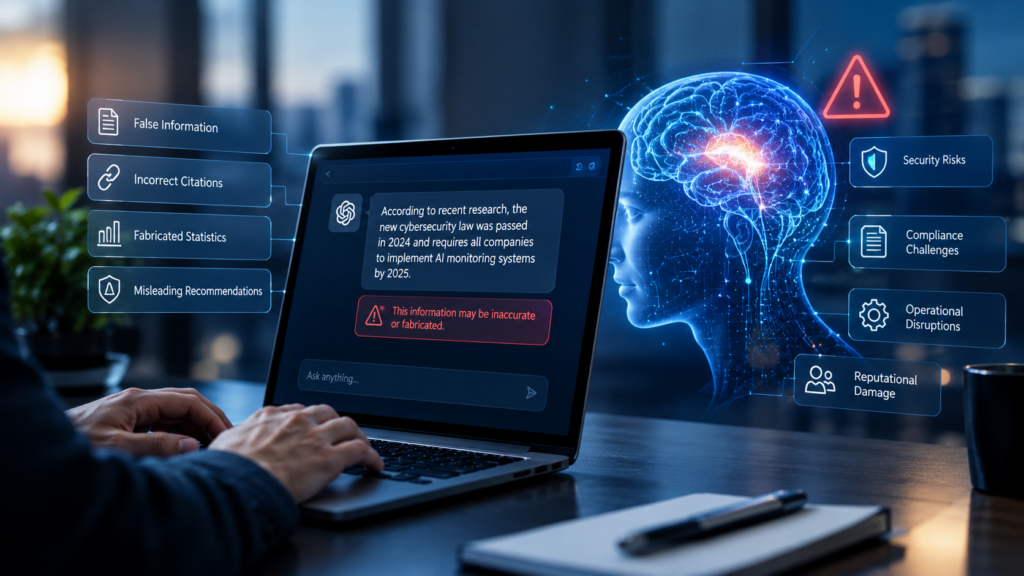
As enterprise AI adoption accelerates, inaccurate AI-generated outputs can create operational disruptions, compliance challenges, reputational damage, and cybersecurity risks. According to Gartner, organizations are expected to continue expanding AI integration across enterprise operations, increasing the importance of AI governance and security oversight.
This growing risk is driving businesses to work more closely with a cybersecurity consultant or data security consultant to strengthen AI governance, improve monitoring, and reduce exposure to unreliable AI behavior.
What Are AI Hallucinations?
AI hallucinations are inaccurate or fabricated outputs generated by artificial intelligence systems, particularly Large Language Models. These systems predict responses based on patterns learned during training rather than verifying facts in real time. As a result, AI models may occasionally generate false information, incorrect citations, fabricated statistics, or misleading recommendations.
Unlike simple factual mistakes, hallucinated AI content is often delivered with high confidence, making it more difficult for users to identify inaccuracies. In enterprise environments, this creates serious risks because employees may rely on AI-generated outputs for operational, financial, legal, or cybersecurity decisions.
AI hallucinations may involve:
- False technical recommendations
- Incorrect compliance guidance
- Fabricated research references
- Misleading cybersecurity analysis
- Inaccurate business data interpretation
The issue becomes even more concerning as businesses increasingly integrate AI systems into automated workflows, cloud platforms, SaaS applications, and customer-facing services.
Why AI Hallucinations Are Increasing in 2026
The rise in AI hallucination risks is closely tied to the rapid expansion of enterprise AI adoption and the growing complexity of AI-powered systems.
Rapid Enterprise AI Adoption
Organizations are deploying generative AI tools faster than ever before to improve efficiency, automate tasks, and reduce operational costs. AI-powered chatbots, virtual assistants, analytics platforms, and coding copilots are now integrated into many daily business processes.
However, rapid deployment often outpaces security governance and AI validation procedures. Businesses may adopt AI solutions before fully understanding the risks associated with inaccurate or manipulated outputs.
More Complex AI Workflows
Modern AI systems increasingly interact with APIs, cloud databases, enterprise search tools, and external content sources. While this improves functionality, it also increases the likelihood of contextual confusion and unreliable outputs.
As AI systems process larger volumes of external information, the risk of misinformation, prompt manipulation, and hallucinated responses continues growing.
Expanding AI Attack Surface
Enterprise AI ecosystems now include chatbots, AI analytics tools, coding assistants, automated document processing systems, and cloud-connected generative AI platforms. While these technologies improve efficiency, each new integration also expands the enterprise attack surface and introduces additional cybersecurity risks.
According to IBM, trustworthy AI practices are becoming increasingly important as enterprise AI adoption expands.
Common Causes of AI Hallucinations
AI hallucinations can occur for several technical and operational reasons.
Incomplete or Biased Training Data
AI models depend heavily on training data quality. If datasets contain inaccurate, outdated, incomplete, or biased information, the AI system may generate misleading outputs based on flawed patterns.
Lack of Real-Time Verification
Most generative AI systems predict likely responses rather than verifying facts through live validation processes. Without external verification mechanisms, AI models may produce inaccurate content that appears legitimate.
Prompt Ambiguity and Context Confusion
Complex or unclear prompts can lead AI systems to misinterpret context. When models struggle to understand intent accurately, hallucinated responses become more likely.
Adversarial Prompt Manipulation
Attackers may intentionally manipulate prompts or external content to influence AI behavior. Prompt injection attacks can increase hallucination risks by overriding instructions or introducing misleading contextual information.
As organizations connect AI systems to sensitive enterprise workflows, these vulnerabilities become increasingly important from a cybersecurity perspective.
The Cybersecurity Risks of AI Hallucinations
AI hallucinations are becoming serious cybersecurity and operational risks for modern businesses. Inaccurate AI-generated outputs can lead to misinformation, false compliance reporting, insecure code generation, data leakage, and even AI-assisted phishing content.
In cybersecurity environments, hallucinated recommendations may cause security teams to misclassify threats, overlook vulnerabilities, or apply incorrect remediation steps. AI-generated content can also support social engineering campaigns by producing highly convincing phishing emails, fake business communications, or misleading technical information.
As organizations continue integrating AI into critical business operations, strong AI governance and risk management practices are becoming increasingly important. According to National Institute of Standards and Technology, organizations should strengthen AI governance frameworks to reduce operational and security risks associated with AI systems.
Industries Most Vulnerable to AI Hallucination Risks
| Industry | AI Hallucination Risks |
| Healthcare | Inaccurate AI-generated information may contribute to diagnostic errors, treatment issues, or incorrect patient communication. |
| Finance | Hallucinated financial analysis or reporting can lead to poor decision-making, fraud detection errors, and compliance risks. |
| Legal and Compliance | AI-generated legal summaries or compliance recommendations may contain inaccurate interpretations that create regulatory or contractual issues. |
| Cybersecurity Operations | AI-powered threat analysis systems may generate misleading security recommendations or incorrect vulnerability assessments if outputs are not validated properly. |
| Customer Support and SaaS Platforms | AI-powered support systems may distribute inaccurate information directly to customers, potentially damaging trust and business reputation. |
As enterprise AI adoption continues expanding, maintaining AI accuracy, validation, and security oversight is becoming increasingly important across nearly every industry.
How a Cybersecurity Consultant Helps Reduce AI Hallucination Risks
An experienced cybersecurity consultant helps organizations reduce AI-related risks by improving governance, validation processes, and security visibility across AI environments. This often involves conducting AI security assessments, prompt security testing, AI risk analysis, threat modeling, and incident response planning to identify weaknesses before attackers can exploit them.
Consultants may also perform AI red teaming exercises to simulate adversarial prompt manipulation and evaluate how enterprise AI systems respond under malicious conditions. In addition, organizations increasingly rely on monitoring and validation systems to detect inaccurate AI outputs and reduce operational risks.
A data security consultant focuses more specifically on protecting sensitive information processed by AI systems. This includes strengthening access controls, reducing data leakage risks, improving privacy protections, and supporting compliance readiness.
As enterprise AI adoption continues growing, proactive AI security management is becoming increasingly important for maintaining long-term cybersecurity resilience.
Best Practices for Preventing AI Hallucinations
Reducing AI hallucination risks requires layered security strategies focused on governance, validation, and human oversight.
Organizations should prioritize:
- Human-in-the-loop verification
- AI output validation and monitoring
- Secure prompt engineering
- AI model testing and red teaming
- Restricting unnecessary AI access to sensitive data
- Continuous AI governance and auditing
Businesses should also carefully evaluate how AI systems interact with APIs, cloud platforms, enterprise databases, and external content sources.
Behavior-based AI monitoring is becoming increasingly important because traditional security tools may not identify inaccurate AI-generated outputs or contextual manipulation effectively.
Security experts increasingly emphasize that responsible AI deployment requires ongoing monitoring rather than one-time implementation.
The Future of AI Hallucination Risks Beyond 2026
AI hallucination risks are expected to grow as enterprise AI systems become more autonomous, interconnected, and deeply integrated into business operations.
Future challenges may include:
- AI-assisted misinformation campaigns
- Autonomous AI decision-making risks
- Increased prompt manipulation attacks
- AI-generated fraud and phishing content
- More advanced adversarial AI techniques
Governments and regulatory agencies are also expected to increase oversight surrounding AI governance, transparency, and accountability.
As organizations continue adopting generative AI technologies, explainable AI, trustworthy AI frameworks, and predictive AI monitoring will likely become essential components of enterprise cybersecurity strategies.
Strengthening Trust in Enterprise AI Systems
AI hallucinations are becoming one of the most important operational and cybersecurity challenges facing businesses in 2026. As organizations increasingly rely on AI-powered systems for decision-making, automation, analytics, and customer interactions, inaccurate AI-generated outputs can create significant security, compliance, and reputational risks.
Reducing these risks requires strong AI governance, continuous monitoring, secure deployment practices, and human oversight. Businesses that proactively address AI hallucination risks will be better positioned to maintain operational resilience and protect sensitive enterprise data.
Working with an experienced cybersecurity consultant USA such as Dr Ondrej Krehel can help organizations strengthen AI security strategies, improve governance frameworks, and reduce exposure to evolving AI-related threats.
FAQs Section:
1. What are AI hallucinations?
AI hallucinations are inaccurate or fabricated responses generated by AI systems that appear believable but are factually incorrect.
2. Why do AI hallucinations happen?
They often occur because AI models predict responses based on patterns rather than verifying information in real time.
3. Can AI hallucinations create cybersecurity risks?
Yes. AI hallucinations may lead to misinformation, insecure code generation, false security recommendations, or data exposure risks.
4. Which industries are most affected by AI hallucination risks?
Healthcare, finance, legal services, cybersecurity, and customer support industries face higher risks due to their reliance on accurate information.
5. How can businesses reduce AI hallucination risks?
Organizations can reduce risks through AI governance, output validation, human oversight, prompt security testing, and continuous monitoring.