
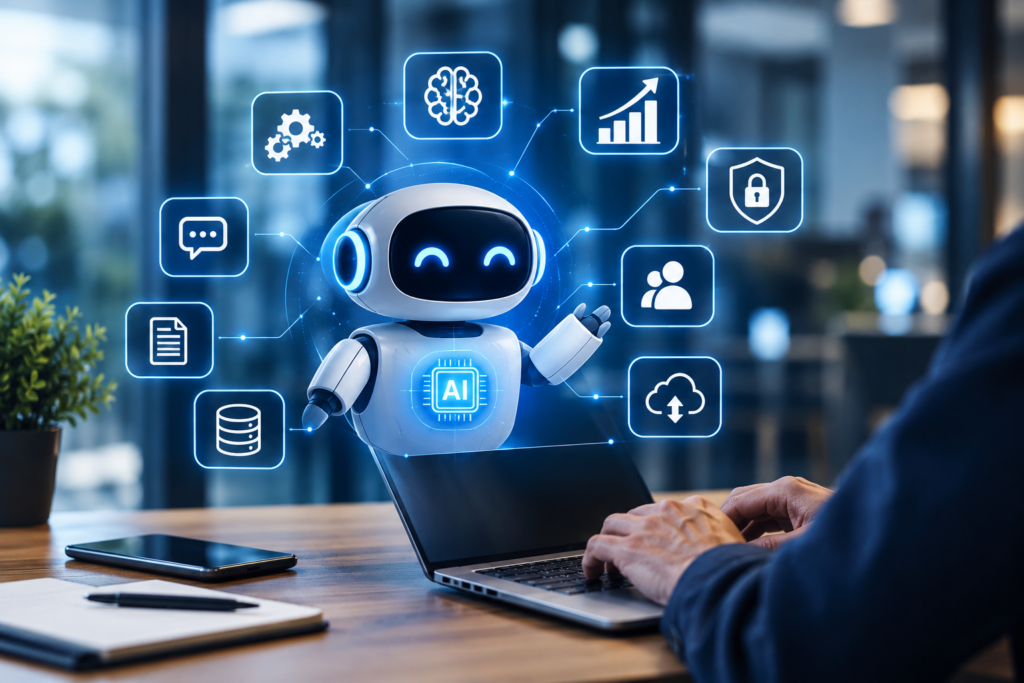
How Intelligent Automation Is Transforming Organizations
Artificial intelligence is rapidly changing how organizations operate, compete, and deliver value. One of the most significant developments in this evolution is the rise of AI Agents’ intelligent software systems capable of making decisions, completing tasks, and adapting to changing conditions with minimal human intervention. Unlike traditional automation tools that follow predefined rules, AI agents can analyze information, reason through complex scenarios, and continuously improve their performance.
Businesses across industries are adopting AI agents to streamline operations, enhance customer experiences, automate repetitive workflows, and support faster decision-making. According to McKinsey’s State of AI 2024, 72% of organizations have adopted AI in at least one business function, while 65% regularly use generative AI, highlighting the rapid shift toward intelligent automation. (McKinsey & Company)
As organizations increasingly rely on AI-driven systems, security and governance become equally important. Working with an experienced cybersecurity consultant helps businesses deploy AI securely, while a data security consultant ensures that the information powering AI agents remains protected throughout its lifecycle.
What Are AI Agents?
AI agents are autonomous software systems designed to perceive information, make decisions, and perform tasks to achieve specific goals. They combine artificial intelligence technologies such as machine learning, natural language processing (NLP), reasoning, and automation to interact with users, applications, and digital environments.
Unlike conventional software that executes fixed instructions, AI agents evaluate changing conditions and adjust their actions based on new information. This ability allows them to solve problems, automate workflows, and support business decisions with minimal human involvement.
The defining characteristics of AI agents include:
- Autonomous decision-making
- Goal-oriented behavior
- Continuous learning and adaptation
- Real-time data analysis
- Interaction with users and other systems
These capabilities make AI agents valuable across a wide range of industries, from customer service and healthcare to finance, cybersecurity, and manufacturing.
How AI Agents Work
AI agents operate through a continuous cycle of observing, analyzing, acting, and learning. While different AI models use different techniques, most intelligent agents follow a similar workflow.
1. Perceive Information
The AI agent gathers information from its environment. This may include user requests, business applications, databases, cloud platforms, sensors, or network activity.
2. Analyze the Data
Using machine learning algorithms, natural language processing, and predefined objectives, the agent interprets incoming information to understand the current situation.
3. Make Decisions
After evaluating available data, the AI agent determines the most appropriate action based on business rules, predictive models, or learned behavior.
4. Execute Tasks
The agent performs the required action, such as generating a report, answering customer questions, blocking suspicious activity, updating records, or automating business workflows.
5. Learn and Improve
Many AI agents continuously refine their performance by analyzing outcomes and incorporating new data. This ongoing learning enables them to improve accuracy and adapt to changing environments over time.
This intelligent decision-making process allows AI agents to automate complex tasks that previously required significant human involvement.
Different Types of AI Agents
Not all AI agents function in the same way. Their capabilities vary depending on the complexity of the tasks they perform and the environments in which they operate.
Simple Reflex Agents
Simple reflex agents respond to predefined conditions using fixed rules. They work well for straightforward tasks where decisions are based solely on current inputs without considering past events.
Model-Based Agents
Model-based agents maintain an internal representation of their environment, allowing them to make better decisions even when they have incomplete information. These agents are commonly used in dynamic business environments where conditions frequently change.
Goal-Based Agents
Goal-based agents evaluate different actions and choose those most likely to achieve specific objectives. They are often used in logistics, planning systems, and business process automation.
Utility-Based Agents
Utility-based agents go beyond achieving goals by selecting actions that produce the most beneficial outcome according to predefined priorities. They are particularly valuable in financial analysis, resource optimization, and decision support systems.
Learning Agents
Learning agents continuously improve their performance by analyzing experience and feedback. These advanced AI systems become more accurate over time and are widely used in recommendation engines, fraud detection, predictive analytics, and cybersecurity.
Business Applications of AI Agents
AI agents are transforming nearly every industry by automating routine tasks, improving operational efficiency, and enabling smarter decision-making.
Some of the most common business applications include:
- Customer Service: AI-powered virtual assistants provide instant responses, resolve common inquiries, and improve customer satisfaction.
- Cybersecurity: AI agents monitor network activity, detect anomalies, identify potential threats, and assist security teams with incident response.
- Financial Services: Banks use AI agents for fraud detection, credit risk analysis, and automated customer support.
- Healthcare: Intelligent agents assist with medical scheduling, patient engagement, diagnostic support, and administrative automation.
- Manufacturing: AI optimizes production planning, predictive maintenance, and quality control across industrial environments.
- Supply Chain Management: AI agents forecast demand, optimize inventory, and improve logistics operations.
- IT Operations: Organizations automate system monitoring, software deployment, troubleshooting, and infrastructure management using AI-driven workflows.
The rapid expansion of enterprise AI reflects its growing business value. According to McKinsey, organizations are using AI across more business functions than ever before, with IT, marketing, product development, and service operations leading adoption. (McKinsey & Company)
As AI agents become more capable, they are shifting from simple automation tools to intelligent digital collaborators that support employees, improve productivity, and accelerate business innovation.
Benefits of AI Agents
AI agents deliver far more than task automation they improve efficiency, accelerate decision-making, and enable organizations to scale operations without significantly increasing costs. By analyzing large volumes of data and executing repetitive processes with speed and accuracy, AI agents allow employees to focus on strategic, high-value work.
Key benefits include:
- Increased operational efficiency and productivity
- Faster, data-driven decision-making
- Reduced operational costs through automation
- 24/7 availability for customer and business support
- Improved customer experiences through personalized interactions
- Better data analysis and business insights
- Enhanced threat detection and response in cybersecurity
According to IBM’s Global AI Adoption Index 2023, 42% of enterprise-scale organizations have actively deployed AI, while an additional 40% are exploring or experimenting with AI, demonstrating its growing role in business transformation. (Source: IBM Global AI Adoption Index 2023)
Cybersecurity Risks of AI Agents
As AI agents become more integrated into business operations, they also introduce new cybersecurity and privacy risks. Because these systems process sensitive data, automate decisions, and interact with multiple applications, attackers are increasingly targeting them to exploit vulnerabilities or manipulate their outputs.
One of the most significant threats is AI-powered phishing and social engineering, where cybercriminals use AI to create highly convincing messages that increase the likelihood of successful attacks. Organizations must also guard against prompt injection attacks, which manipulate AI models into producing unauthorized or harmful responses, as well as model manipulation that can compromise system integrity.
Data protection is another major concern. AI agents often handle confidential business information, making data leakage, unauthorized access, and privacy compliance critical issues. In addition, AI hallucinations can generate inaccurate or misleading content, while vulnerabilities within third-party AI services and supply chains may expose organizations to additional cyber risks.
To reduce these threats, organizations should implement strong AI governance, continuous monitoring, robust access controls, and regular security assessments to ensure AI systems remain secure, reliable, and compliant.
Best Practices for Secure AI Agent Deployment
Successfully deploying AI agents requires balancing innovation with security. Organizations should integrate AI into their cybersecurity strategy rather than treating it as a standalone technology.
Recommended best practices include:
- Establish a formal AI governance framework.
- Adopt a Zero Trust security model.
- Enforce strong Identity and Access Management (IAM) and Multi-Factor Authentication (MFA).
- Encrypt sensitive data used by AI systems.
- Continuously monitor AI activity for abnormal behavior.
- Conduct regular AI security and risk assessments.
- Maintain human oversight for high-risk decisions.
- Keep AI models updated to address emerging threats and vulnerabilities.
A proactive approach helps organizations maximize the benefits of AI while minimizing operational and security risks.
How a Cybersecurity Consultant and Data Security Consultant Enable Secure AI Adoption
Successfully implementing AI agents requires more than advanced technology it demands strategic planning, governance, and strong security controls. An experienced cybersecurity consultant, such as Dr. Ondrej Krehel, helps organizations assess AI-related risks, secure cloud and enterprise environments, strengthen identity and access management, and develop AI security strategies aligned with business objectives.
Working alongside these efforts, a data security consultant focuses on protecting the information that powers AI systems. Through data governance, encryption, Data Loss Prevention (DLP), access controls, and regulatory compliance, they help ensure sensitive data remains secure throughout its lifecycle. Together, a cybersecurity consultant and data security consultant enable organizations to deploy AI confidently while reducing cyber risk and supporting long-term operational resilience.
The Future of AI Agents in Business and Cybersecurity
AI agents are evolving from task-specific assistants into intelligent systems capable of managing complex workflows, supporting strategic decision-making, and enhancing cybersecurity operations. Future advancements in agentic AI, predictive analytics, and autonomous decision-making will allow organizations to automate increasingly sophisticated business processes.
In cybersecurity, AI-powered Security Operations Centers (SOCs), automated threat hunting, and predictive threat intelligence will strengthen defenses against rapidly evolving cyber threats. At the same time, organizations must address challenges related to AI governance, transparency, ethics, and regulatory compliance.
Businesses that combine intelligent automation with strong security practices will be better positioned to innovate while maintaining trust and resilience.
Building Secure AI Strategies for the Future
AI agents are transforming the way organizations operate by automating workflows, improving decision-making, and increasing operational efficiency. As their capabilities continue to expand, they are becoming essential tools for digital transformation across nearly every industry.
However, successful AI adoption requires more than deploying intelligent software. Organizations must balance innovation with security by implementing strong governance, protecting sensitive data, and continuously managing cyber risks. Working with an experienced cybersecurity consultant USA helps businesses develop secure AI strategies, while a data security consultant ensures the information powering AI systems remains protected.
By combining intelligent automation with proactive cybersecurity, organizations can unlock the full value of AI agents while building a resilient foundation for future growth.
FAQs Section:
1. What are AI agents?
AI agents are intelligent software systems that analyze information, make decisions, and perform tasks autonomously to achieve specific goals.
2. How do AI agents work?
They collect data, analyze information, make decisions, execute tasks, and continuously improve through machine learning and feedback.
3. What are the different types of AI agents?
The main types include simple reflex, model-based, goal-based, utility-based, and learning agents.
4. Are AI agents secure?
AI agents can be secure when supported by strong governance, access controls, encryption, continuous monitoring, and regular security assessments.
5. Why should organizations work with a cybersecurity consultant?
A cybersecurity consultant helps organizations securely deploy AI, manage cyber risks, strengthen security controls, and align AI initiatives with business objectives.