
The Growing Threat of LOTL Attacks in Modern Cybersecurity
As cyber threats continue evolving in 2026, attackers are increasingly shifting away from traditional malware and adopting stealth-based techniques designed to evade detection. One of the fastest-growing threats affecting organizations today is the rise of Living Off the Land (LOTL) attacks.
Unlike conventional cyberattacks that rely on malicious executables, LOTL attacks abuse legitimate system tools already present within operating systems and enterprise environments. By leveraging trusted applications such as PowerShell, Windows Management Instrumentation (WMI), and command-line utilities, attackers can move through networks while avoiding many traditional security controls.
This stealth-focused approach makes LOTL attacks especially dangerous for businesses handling sensitive customer data, financial records, or cloud-based infrastructure. As a result, many organizations now rely on a cybersecurity consultant or data security consultant to identify hidden vulnerabilities, strengthen endpoint visibility, and reduce the risk of advanced fileless attacks before major damage occurs.
Cybersecurity researchers have observed a significant rise in fileless and malware-less attack activity in recent years, particularly within enterprise environments where attackers seek long-term persistence and low detection rates.
What Are Living Off the Land (LOTL) Attacks?
Living Off the Land (LOTL) attacks are cyberattacks in which threat actors exploit legitimate tools, processes, and administrative utilities already installed on a system instead of deploying traditional malware.
These attacks are commonly referred to as fileless or malware-less attacks because they often leave very few traces on disk. Instead of introducing suspicious executables, attackers blend into normal system activity by abusing trusted applications that organizations regularly use for administration and automation.
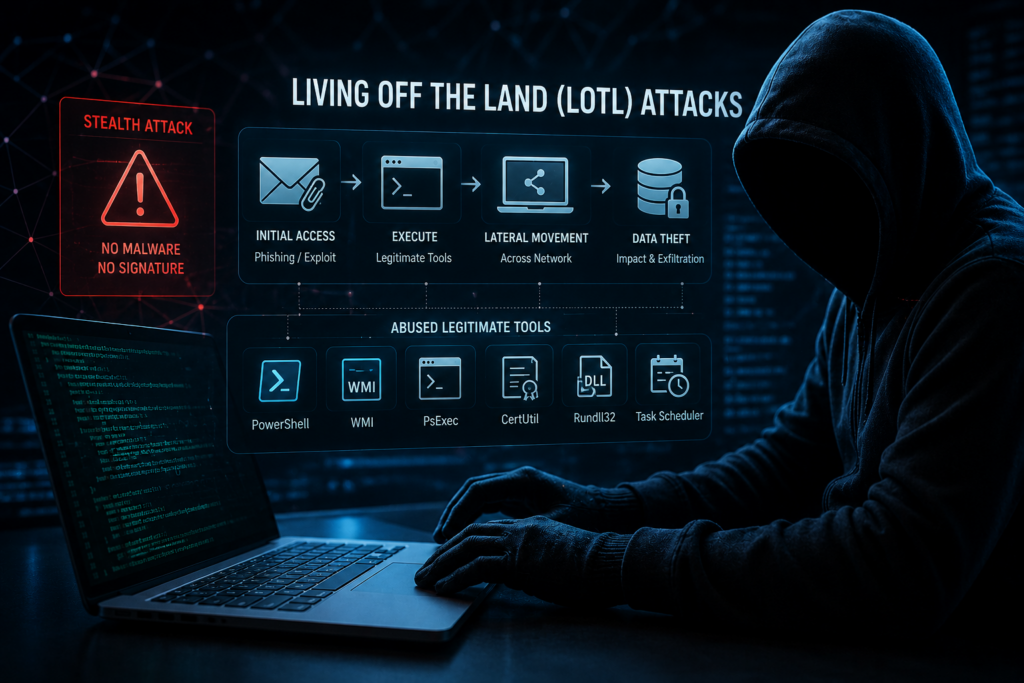
Commonly abused tools include:
- PowerShell
- WMIC
- PsExec
- Rundll32
- CertUtil
- Windows Task Scheduler
Because these tools are legitimate components of operating systems, traditional antivirus solutions may struggle to distinguish malicious behavior from normal administrative activity.
According to a cybersecurity expert, fileless attack techniques have become increasingly popular among advanced persistent threat (APT) groups because they reduce detection opportunities and allow attackers to maintain stealth for extended periods.
Related: How Keylogger Threats Are Evolving In 2026
How LOTL Attacks Work
Living Off the Land (LOTL) attacks usually begin through common entry points such as phishing emails, stolen credentials, or unpatched system vulnerabilities. Once attackers gain access, they avoid deploying obvious malware and instead abuse legitimate system tools already present within the environment.
Typical Stages of a LOTL Attack
- Initial compromise through phishing or credential theft
- Abuse of native tools such as PowerShell or WMI
- Credential dumping and privilege escalation
- Lateral movement across connected systems
- Data theft, ransomware deployment, or persistence establishment
Attackers commonly use PowerShell scripts to execute remote commands, automate malicious tasks, and interact directly with system memory. WMI is also frequently abused for remote administration and persistence while avoiding obvious security alerts.
Because these tools are legitimate components of enterprise systems, LOTL activity often blends into normal administrative operations. This makes detection and forensic investigation far more difficult for security teams.
Recent threat intelligence reports show that LOTL techniques are increasingly used in ransomware campaigns, cyber espionage operations, and large-scale enterprise breaches due to their stealth and low detection rates.
Related: Cross-Site Scripting (XSS) Attacks And How They Work
Why LOTL Attacks Are Dangerous for Businesses
Living Off the Land (LOTL) attacks are especially dangerous because they are designed to bypass traditional security defenses by using trusted system tools already present within enterprise environments. Since the activity often appears legitimate, both users and automated security systems may struggle to recognize malicious behavior early.
This lack of visibility allows attackers to remain inside networks for longer periods, increasing the risk of credential theft, ransomware deployment, sensitive data exposure, and unauthorized access to critical systems. Unlike traditional malware attacks that may trigger antivirus alerts, LOTL attacks often leave very little forensic evidence, making detection and incident response far more difficult.
For businesses, the consequences can include operational disruption, financial losses, compliance violations, reputational damage, and loss of customer trust. Cybersecurity experts continue to observe a growing shift toward stealth-based and credential-focused attack strategies because they are often more effective and harder to detect than conventional malware campaigns.
Related: Cloud Security Posture Management (CSPM): Securing Multi-Cloud Environments In 2026
Common Tools Used in LOTL Attacks
Attackers commonly exploit legitimate administrative tools known as LOLBins (Living Off the Land Binaries) to conduct malicious operations without introducing external malware.
PowerShell
PowerShell is one of the most abused tools in modern LOTL attacks because it allows remote command execution, script automation, and direct interaction with system processes.
Windows Management Instrumentation (WMI)
WMI enables remote management and system monitoring, but can also be exploited for lateral movement and persistence.
CertUtil
Originally designed for certificate management, CertUtil is frequently abused to download malicious payloads or encode data.
Rundll32
Attackers use Rundll32 to execute malicious DLL files while disguising activity as legitimate Windows processes.
PsExec
PsExec enables remote command execution across systems and is often used during ransomware deployment or privilege escalation.
Security researchers have observed increasing abuse of native Windows binaries because they are widely trusted and rarely blocked within enterprise environments.
Related: Synthetic Identity Fraud In 2026: A Growing Challenge For Cybersecurity
Why LOTL Attacks Are Hard to Detect
One of the biggest challenges with LOTL attacks is that attackers intentionally blend into legitimate administrative activity. Traditional security solutions often rely on malware signatures or suspicious executable detection, but LOTL attacks may never introduce detectable malware files.
Several factors contribute to detection difficulty:
- Use of trusted system utilities
- Fileless execution techniques
- Minimal disk artifacts
- Legitimate administrator-like behavior
- Encrypted communications and remote execution
Because of this, organizations increasingly rely on behavioral threat detection and endpoint detection and response (EDR) systems that analyze system activity patterns instead of relying solely on known malware signatures.
Modern cybersecurity teams now focus heavily on anomaly detection, threat hunting, and user behavior analytics to identify suspicious activity that traditional tools may overlook.
Related: Voice Cloning Scams: How AI Is Transforming Cyber Fraud In 2026
How a Cybersecurity Consultant Helps Prevent LOTL Attacks
A cybersecurity consultant plays a critical role in helping businesses identify weaknesses that attackers could exploit through LOTL techniques. Instead of relying only on reactive security measures, consultants focus on proactive threat reduction and continuous monitoring.
Key areas of focus include:
Threat Hunting and Behavioral Analysis
Advanced monitoring systems help identify unusual system behavior associated with PowerShell abuse, credential dumping, or lateral movement.
Penetration Testing
Ethical hackers simulate real-world LOTL attack scenarios to uncover weaknesses before cybercriminals exploit them.
Endpoint Security Reviews
Consultants evaluate endpoint visibility, logging configurations, and EDR effectiveness across enterprise systems.
Security Architecture Improvements
Organizations receive guidance on reducing attack surfaces, restricting administrative privileges, and implementing Zero Trust principles.
At the same time, a data security consultant helps protect sensitive information by improving encryption practices, strengthening access controls, and developing compliance-focused security strategies.
Together, these approaches significantly reduce exposure to stealth-based attacks and unauthorized access attempts.
Related: Cloud Data Security: Best Practices To Protect Enterprise Data In 2026
The Future of LOTL Attacks and How Businesses Can Defend Against Them
As cyber threats continue evolving in 2026 and beyond, Living Off the Land (LOTL) attacks are expected to become even more advanced and difficult to detect. Attackers are increasingly using automation, AI-assisted techniques, cloud-based infrastructure, and legitimate SaaS platforms to carry out stealth-based operations while avoiding traditional security controls. The growing use of fileless ransomware, encrypted communications, and trusted administrative tools is also making these attacks more sophisticated across enterprise environments.
To defend against these evolving threats, organizations need a layered cybersecurity strategy focused on visibility, behavioral monitoring, and strict access control. Key security measures include implementing Zero Trust frameworks, restricting unnecessary administrative privileges, monitoring PowerShell and scripting activity, deploying advanced endpoint detection and response (EDR) solutions, and enforcing multi-factor authentication (MFA).
Regular security audits, penetration testing, and employee cybersecurity awareness training are equally important, especially since phishing remains one of the most common entry points for LOTL attacks. Security experts increasingly emphasize behavior-based monitoring because traditional antivirus solutions alone are often insufficient against modern fileless attack techniques.
As stealth-based cyberattacks continue growing in complexity, businesses that invest in proactive monitoring and strong cybersecurity strategies will be far better positioned to reduce risk and maintain long-term operational resilience.
Related: Medusa Ransomware: How This Threat Is Targeting Modern Enterprises
Strengthening Business Security Against LOTL Attacks
Living Off the Land (LOTL) attacks have become one of the most dangerous forms of modern cyber threats because they exploit trusted system tools while avoiding traditional detection methods.
For businesses operating in cloud environments, remote work ecosystems, and highly connected enterprise networks, proactive cybersecurity is now essential. Relying solely on reactive security solutions is no longer enough to defend against stealth-based attacks.
Working with an experienced cybersecurity consultant USA, such as Dr. Ondrej Krehel, helps organizations improve threat visibility, strengthen endpoint security, reduce attack surfaces, and protect sensitive business data from advanced fileless attacks.
As LOTL techniques continue evolving in 2026 and beyond, organizations that invest in continuous monitoring, behavioral threat detection, and layered security strategies will be far better positioned to maintain resilience against modern cyber threats.
Related: Identifying and Mitigating Living Off the Land Techniques
FAQs Section:
1. What are Living Off the Land (LOTL) attacks?
LOTL attacks are cyberattacks where hackers abuse legitimate system tools and applications instead of using traditional malware to avoid detection.
2. Why are LOTL attacks difficult to detect?
These attacks use trusted administrative tools like PowerShell and WMI, making malicious activity appear similar to normal system operations.
3. What tools are commonly used in LOTL attacks?
Attackers frequently exploit tools such as PowerShell, WMIC, PsExec, CertUtil, and other native Windows utilities.
4. How can businesses defend against LOTL attacks?
Businesses can reduce risk through Zero Trust security, endpoint monitoring, multi-factor authentication (MFA), penetration testing, and employee cybersecurity training.
5. What role does a cybersecurity consultant play in LOTL protection?
A cybersecurity consultant helps identify vulnerabilities, monitor suspicious behavior, improve endpoint security, and strengthen defenses against stealth-based attacks.